

A lot of multifamily teams are still making budget decisions off reports that can’t see the full prospect journey.
That’s how you end up with numbers like this:
66% of ad spend going to campaigns that book zero tours.
Zero!
And yet the budget stays in place because the reporting still looks “fine.”
The property website shows up as the top source. Lead volume looks steady. Leasing says traffic feels soft, but nothing in the dashboard clearly tells you what to cut, what to fix, or what to trust.
So the spend keeps running.
This is the attribution trap multifamily has been living in for years.

Your website keeps getting credit because it’s usually the last stop before a guest card gets filled out. But that doesn’t mean it created the demand. It just means your system saw the handoff and missed everything that came before it.
A Google ad created awareness. An ILS listing kept the prospect moving. A retargeting ad brought them back. Then the website collected the form and took the credit.
That story is showing up in more reports than most teams realize.
And once the full journey becomes visible, a lot of “top-performing” sources start looking very different.
A Quick Way to Check If This Is Happening to You
IF your property website shows 60%+ of your leads
→ THEN your system is likely only seeing the last click
IF your ad spend hasn’t changed in 12 months
→ THEN it’s probably built on incomplete attribution
IF your reports always look clean, but leasing performance feels inconsistent
→ THEN there’s a gap between what’s happening and what’s being measured
Where AI Comes In (And Why This Is Showing Up Now)
This is where AI starts to matter because it removes the blind spots.
Most vendors will tell you AI is a faster version of what you already have.
Faster reports. Smarter dashboards. More automation. Your team saves time. Ownership meetings get shorter.
All true. Easy to sell. Who says no to that?
But in the latest episode of The Intelligence Fabric, Mike Brewer points to the other half of the story. The half that doesn’t show up in pitch decks.
When AI connects your data properly, the first thing it does isn’t make you faster. It shows you things that were always there, but your old system couldn’t see.
Think about GPS.
Before GPS, taxi drivers and truck drivers knew their cities by heart. Routes they trusted. Roads they always took. Years of experience, nothing to question.
Then GPS came in.
For a lot of them, GPS revealed that the route they had been taking for five years was two minutes longer than it needed to be.
Every single day. Years of experience, and the map still had a blind spot they never knew was there.
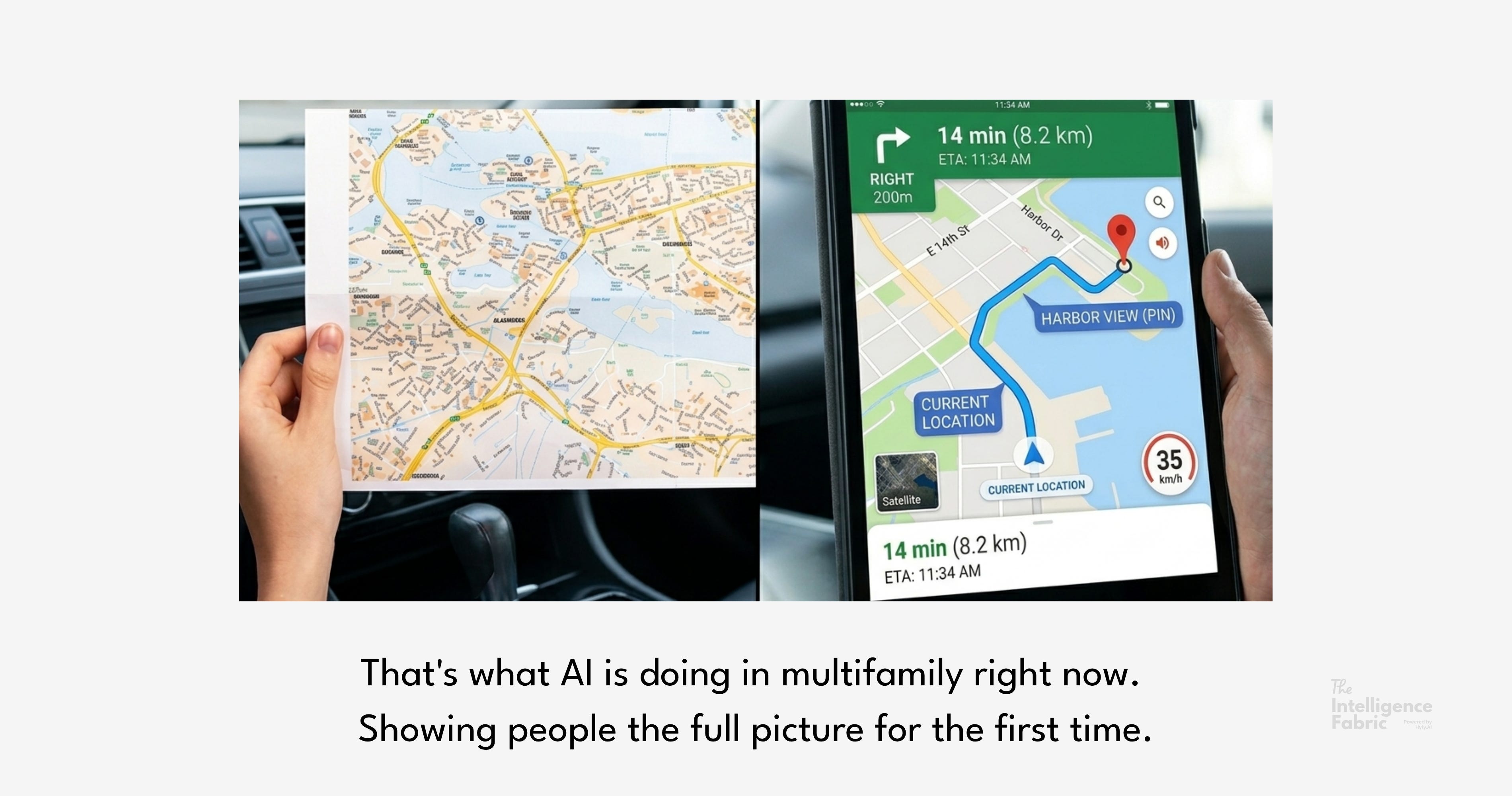
That’s what AI is doing in multifamily right now. Showing people the full picture for the first time.
The Part That Makes Multifamily Uncomfortable
When AI connects your data properly, it shows you how you were actually making decisions before. And sometimes that picture is uncomfortable.
Take the most common example in multifamily.
For years, you’ve been told that your property website drives 60, maybe 70 percent of your leases. That number lives in your CRM. It shows up in every report. You built your budget around it. You pulled money from Google Ads because the website was already “performing.” You defended that story in ownership meetings. Multiple times. With confidence.
The report was working exactly as designed. It could only see the last step.
What most CRMs do is give all the credit to the last thing a prospect clicked before filling out a guest card. And the last click is almost always the property website. So the website looks like the hero of every single lease.
But think about how a real prospect actually behaves.
They see a Google ad on a Tuesday.
Don’t click it but notice the property name.
Three days later they search for apartments in the area and land on your ILS listing.
They browse, they leave.
A week later a retargeting ad shows up on their Instagram.
They click it this time, go to your website, look at floor plans, and fill out the guest card.
Who gets the credit in your CRM?
The website!
Who actually did the work?
Google. The ILS. The retargeting ad. The website was just the last stop on a journey it didn’t start.
And your budget has been built on that incomplete version of the story for years.
What Monday’s Leasing Call Sounds Like When the Data Finally Connects
Here’s what Monday’s leadership call looks like when the data can only see the last click.
Someone pulls up the marketing report.
Website is the top source again. 72 percent. Budget looks fine.
Everyone moves on.
A regional says leads are soft at one property but nobody can tell if it’s the ILS, the ad spend, the pricing, or something on the ops side.
The meeting ends with “let’s keep an eye on it.”
Same call next week.
Here’s what the same meeting looks like when the full journey is visible.
Someone pulls up the actual prospect flow.
Three properties show a drop in tour-to-application conversion that started six weeks ago.
It traces back to a pricing adjustment that made two floor plans uncompetitive.
A pricing problem, caught through marketing data.
The call ends in twelve minutes with a clear action, and someone owns it.
<aside> 👉🏼
Do you know that 53 percent of leads are falsely credited to the property website? And 66 percent of the ad budget goes to campaigns that book zero tours.
</aside>
Read that second number again. Two-thirds of ad spend. Zero tours.
Months, sometimes years, of budget going to the wrong place.
Tyler Holmes from PeakMade lived this. His team doubled budgets, added tools, ran campaigns, and leasing velocity didn’t move. When attribution connected, the website’s 80 percent lead share dropped to 45 percent. Google, ILS, retargeting. All contributing to leases but getting no credit. Finally showed up in the numbers.
This Is Mike’s Real Point in Episode 7
AI shows you how you were actually making decisions before the data connected. The story your judgment was built on gets tested.
Nobody made bad decisions on purpose. Decisions were made in good faith with the information available. The information just had a blind spot.
When the full picture comes in, and it’s different from what you thought, there are two kinds of people in that room.
The first gets defensive. They explain why the old numbers still make sense. They find a reason the new picture might be wrong. The meeting ends, and nothing changes. Six months later, they’re back in the same conversation, wondering why things aren’t moving. (You know this person. You might have been this person. It’s fine.)
The second sits with it for a minute and asks one question: what do we do with this?
Uncomfortable. But moving.
The operators who make that second call won’t send a press release about it. They’ll just start showing up to ownership meetings with cleaner answers. They’ll stop spending the first twenty minutes of every Monday arguing about which number is right. They’ll make budget calls that hold up because the chain from spend to lease is finally visible. Defended positions. Real data behind them.
The question to bring to your next leadership meeting is this:
How much of what we’re defending right now is based on what actually happened, and how much is based on what our system could see at the time?
Start there. The rest follows.
AI will show you the answer either way.
Watch Episode 7 of The Intelligence Fabric here: