
One quick note before we start: if your inbox already feels a little full, that’s fair. This isn’t here to add noise — it’s here because something keeps coming up in conversations across multifamily, and it’s worth naming.
Think about your last week at work. How many hours did you spend in meetings? Now, how many actual decisions came out of them?
Not action items or “next steps.”
Decisions. Things that moved.
If you’re honest, the ratio is embarrassing. And you’re not alone.
The Expensive Space Between Knowing and Doing
Your team has dashboards. Reports auto-generate on time. The data is there, accurate, available.
The stack is built. BI tools, CRMs, PMSs, marketing platforms — all connected, all feeding data.
And absolutely nothing happens faster because of it.
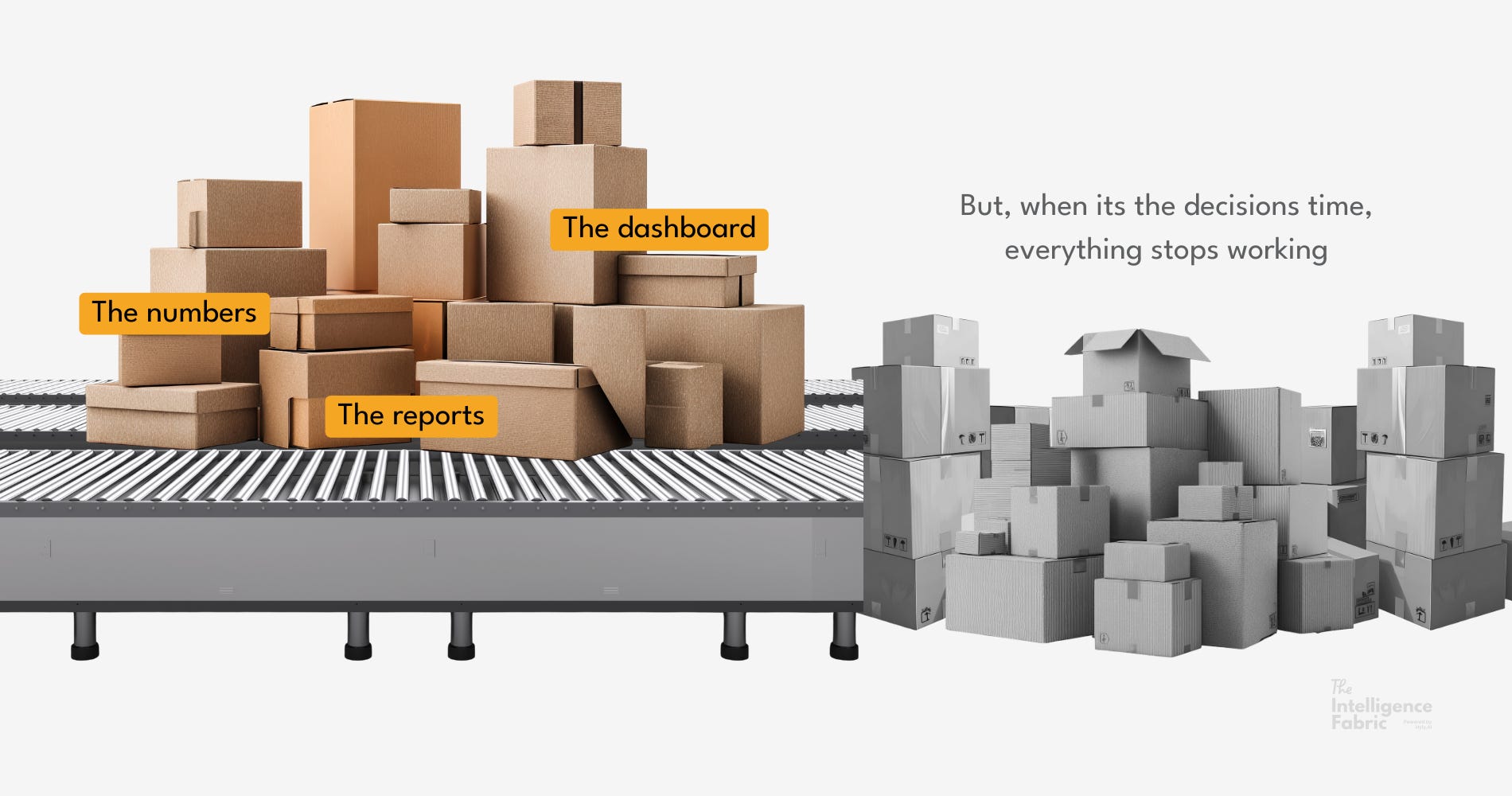
Here’s the part nobody says out loud: data doesn’t make people move. Conviction does. And conviction comes from understanding, not information.
Think about the last time a decision actually flew through your organization. When something went from idea to execution without getting stuck in committee purgatory.
I guarantee it wasn’t because someone had a better spreadsheet.
It was because the right people had enough shared context to say “yes, let’s go” without needing a two-hour debrief first.
That’s rare now. And it’s getting rarer.
The space between “we have the data” and “we made the call” has quietly become the most expensive real estate in your organization. And nobody’s managing it.
So we fill it with meetings. More meetings. Meetings about meetings. We tell ourselves we’re being thorough, collaborative, aligned.
But we’re actually just manually reconstructing context — over and over — because there’s no shared foundation to build on.
Every decision starts from zero. Every conversation relitigates the basics. Every meeting is a first date with reality.
And that doesn’t just slow you down. It exhausts your team. Because the smartest people in your organization aren’t building — they’re translating. They’re explaining. They’re bridging gaps that shouldn’t exist in the first place.
This happens because information and action got separated somewhere along the way.
The data shows up. The reports generate. The numbers are available.
But the understanding that would let people move on those numbers? That’s somewhere else. Trapped in someone’s head. Buried in Slack threads. Lost between systems that don’t talk to each other.
And when understanding doesn’t travel with information, you get exactly what you see in those endless meetings: people working backward from numbers, trying to reconstruct meaning in real time.
That’s not a meeting problem. That’s a structure problem.
When Everyone Sees Something Different
Here’s a scene that plays out every week in multifamily.
Four people sit down. Same report in front of all of them. Within fifteen minutes, there are three different theories about what’s happening and zero agreement on what to do next.
Is that a data problem? No. The data is identical.
It’s a meaning problem.
And meaning problems are sneaky because they don’t look like problems. They look like healthy debate. They look like due diligence. They look like “we just need to dig deeper.”
It’s the organizational equivalent of driving with the parking brake on. The car still moves. You just burn twice the fuel and wonder why everything smells hot.
But what’s actually happening is simpler and worse: your organization has no shared language for what the numbers mean.
Revenue is up — but is that good? Depends who you ask.
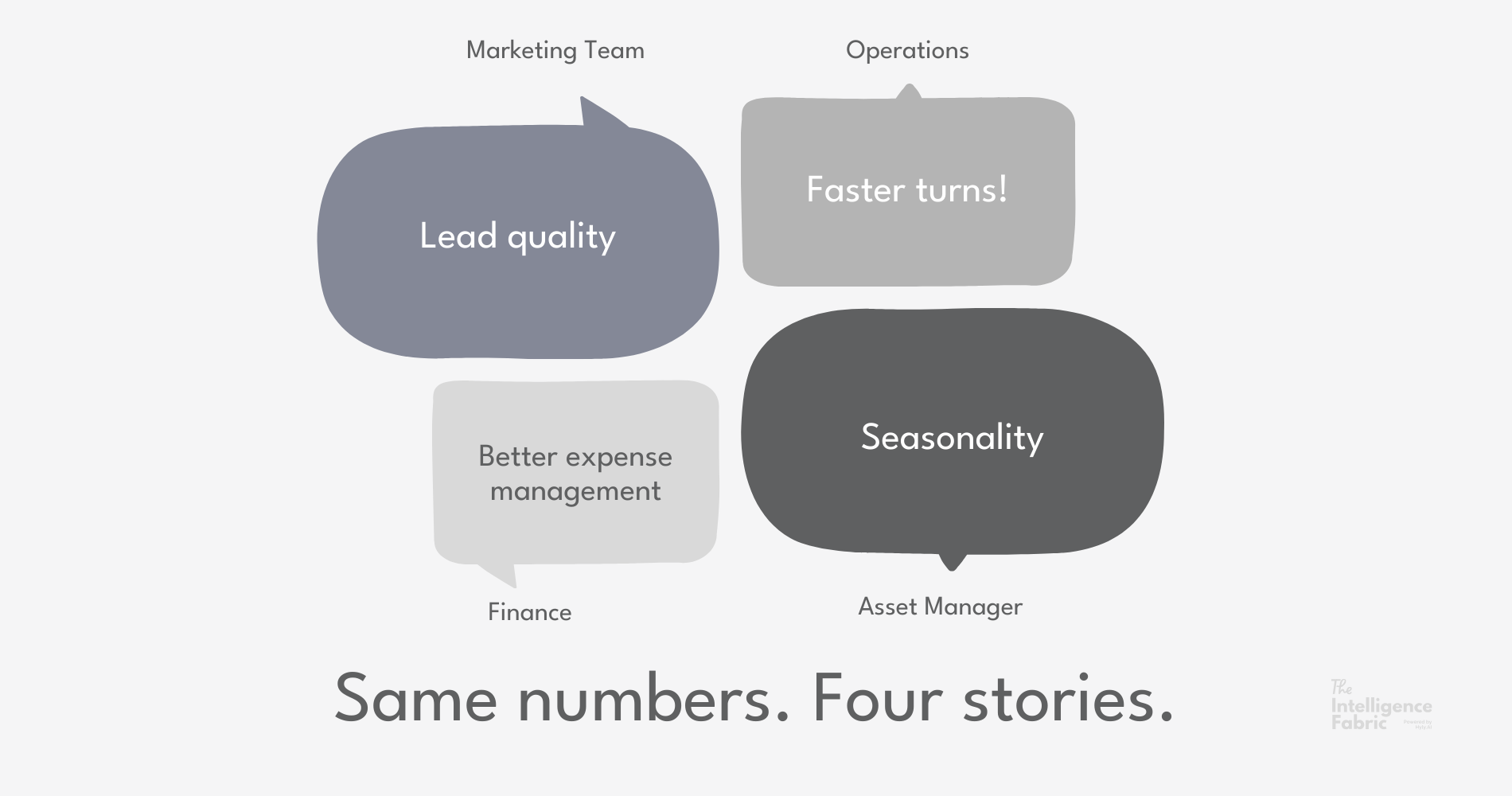
Marketing will say it's because lead quality improved. Operations will point to faster turns. Finance will credit better expense management. And the asset manager will say it's just seasonal variance.
They're all looking at the same outcome. But they're telling four different stories about why it happened. And next month, when revenue dips, they'll each have a different theory about that too.
We saw this play out in a LinkedIn thread this week. Eric Brown and Mike Whaling were going back and forth about marketing attribution, and Mike said something that stuck:
“Attribution is a misnomer we need to drop as an industry.”
He’s right. When your CRM credits one source for a lease that touched six channels over three weeks, you’re not seeing the full picture. You’re seeing one fragment. And when you make budget decisions based on that fragment, you end up cutting the things that were actually working.
Same problem. Different systems telling different stories. Decisions made based on partial truth. That’s why your best operators don’t stick around. Not because the work is hard — they signed up for hard. But because every week feels like Groundhog Day.
And the really expensive part? You’re not getting better answers from all this deliberation. You’re just getting slower ones.
When meaning has to be reconstructed every time, speed becomes impossible. Not because people aren’t working hard enough. Because the structure forces them to rebuild understanding from fragments before they can move.
Intelligence That Walks Out the Door
Pop quiz. If your best regional manager quit tomorrow, how much understanding walks out the door?
In most multifamily organizations, the answer is ugly. Because intelligence doesn’t live in the organization. It lives in specific people. Specific heads. Specific relationships.

That’s a bus factor of one. Your company’s ability to make good decisions is only as durable as your retention rate.
This isn’t a people problem. Your people are doing heroic work. It’s a structure problem.
Right now, intelligence in multifamily lives in fragments.
Operations has one view of reality. Marketing has another. Revenue tells a different story. Customer experience adds more context. And leadership is left stitching together meaning after the fact.
We usually call that management. But in practice, it’s manual interpretation — people assembling partial understanding and hoping it holds long enough to make a decision.
That approach works when things are small. When portfolios are simpler. When systems are fewer. When decisions don’t have to travel very far.
But scale changes the rules.
As organizations grow, intelligence can’t live in people’s heads or in disconnected tools. When it does, every decision depends on who’s in the room, what they remember, and how well they can explain it.
I saw this with a portfolio team recently. They had beautiful dashboards everywhere. Occupancy, revenue, expenses, resident satisfaction, maintenance efficiency — all tracked, all optimized.
But no one could tell you why turnover was up at three specific properties until someone physically visited and realized all three had the same regional manager who was burned out and checked out.
The signal was there the whole time. Maintenance response times slipping. Resident complaints clustering. Team surveys showing low morale.
But those signals lived in three different systems, owned by three different departments, reviewed in three different meetings. So the intelligence existed — it just couldn’t flow.
And that’s what happens when understanding is trapped. You have all the pieces. They just never connect.
The Missing Layer
When you step back, all three breakdowns point to the same thing.
Information needs a way to turn into action. Data needs a way to hold shared meaning. And intelligence needs a way to persist instead of fragmenting.
Multifamily built the stack. The tools are there. The systems are integrated. The data flows.
But the stack was never designed to carry meaning. It was designed to move information.
That missing layer — the one that allows intelligence to move, survive, and scale — is what we call the Intelligence Fabric.
Not a product. Not another platform. A way of thinking about how intelligence should live inside an organization — shared, consistent, and reusable — instead of trapped in tools or people’s heads.
The stack connects your systems. The fabric connects your understanding.
When intelligence is fragmented, teams argue about numbers. When intelligence is carried forward, teams argue about direction.
And that’s a much better conversation to be having.
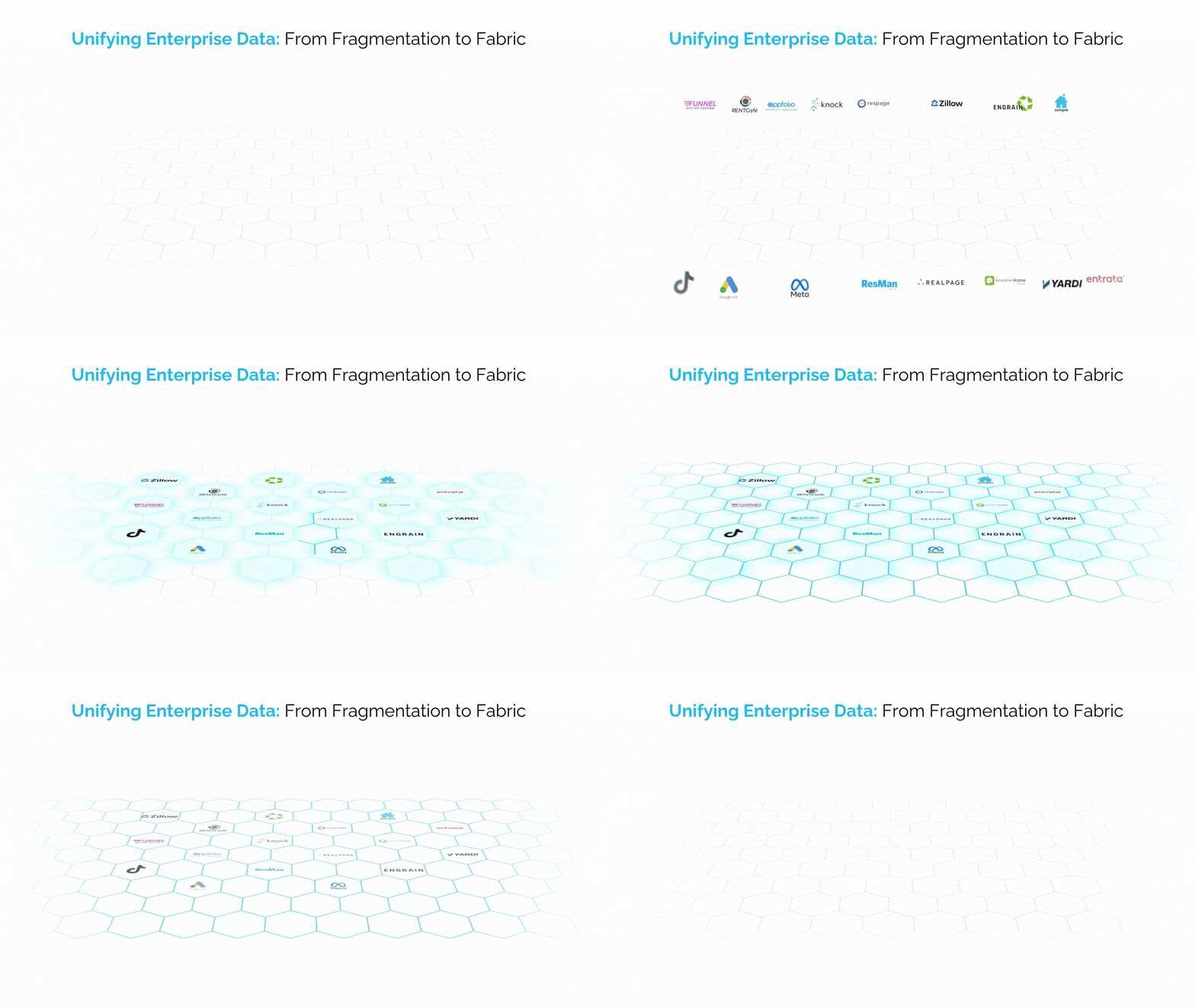
The resolution isn’t more meetings or better dashboards. It’s intelligence that lives as structure instead of interpretation — so understanding survives growth, turnover, and change.
When context travels with the data, decisions don’t have to be rebuilt every time. When meaning is shared, teams stop debating numbers and start debating direction. And when intelligence stops living in fragments, something different becomes possible.
Next time you’re in a meeting that should’ve been a decision, notice which of these three cracks you’re standing in.
The gap between information and action. The absence of shared meaning. Or intelligence that’s trapped instead of flowing.
Once you see them, you can’t unsee them.
Until then, hope this gave you something useful to think about.