
The Intelligence Fabric | Season 1 Finale
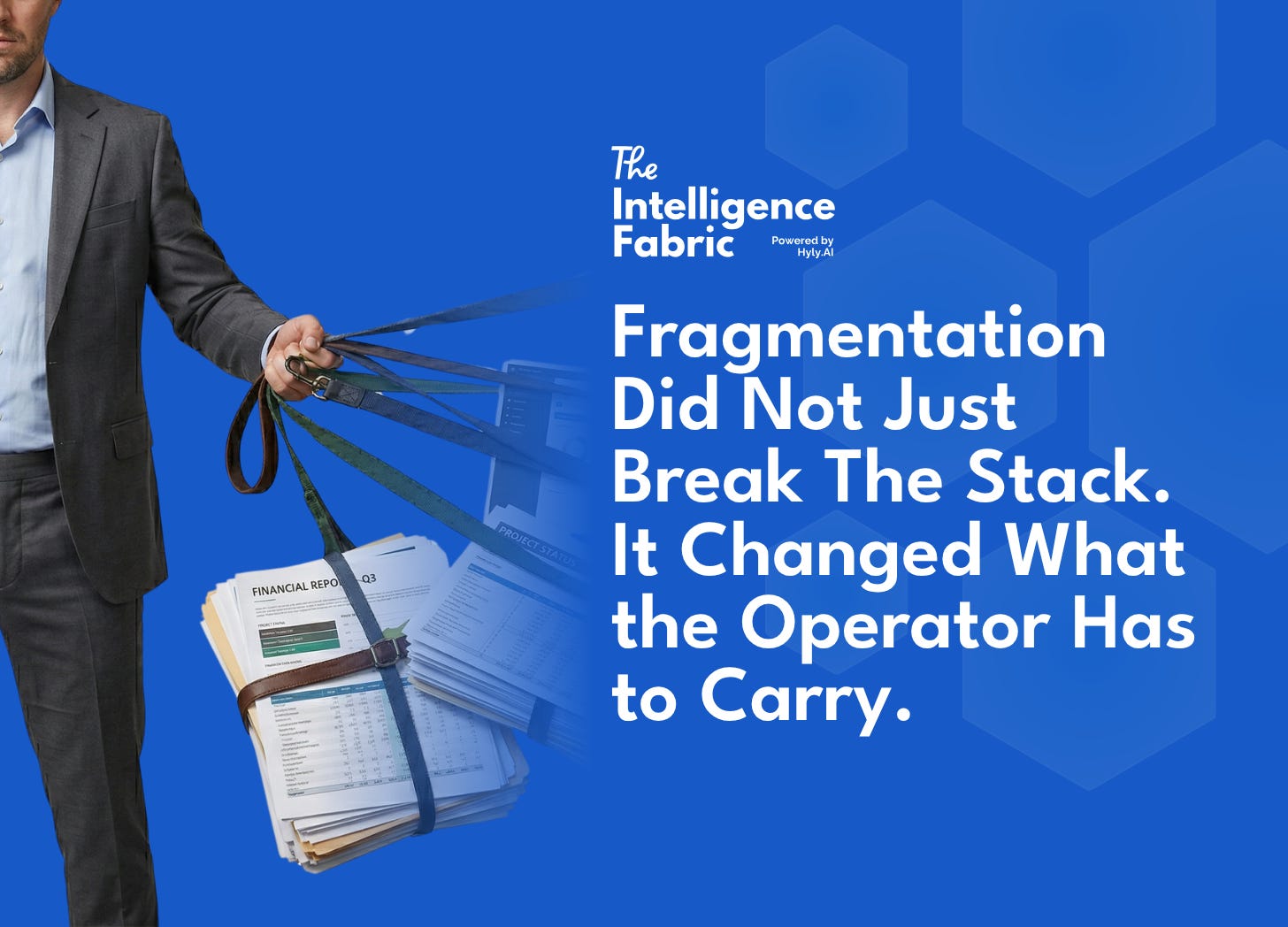
There is a pattern in fragmented organizations that almost never gets named correctly, because it does not look like a problem from the outside. It looks like strong leadership. It looks like the right person in the room, making the call.
👉🏼 What is actually happening is this:
a system that cannot carry understanding on its own has found a person to do it instead. Over time, that arrangement quietly reshapes the operator’s job in ways that compound without ever announcing themselves.
This is where Season 1 of The Intelligence Fabric has been pointing out.
the pres s the hsye st yannmimd hsjjass asjk kksssmjsdjjdjdsaaljjdadadsjdj
Multifamily Problem Was Never the Data
Fragmentation in multifamily tends to get described as a technology problem: too many tools, overlapping platforms, systems that refuse to talk to each other. That framing is accurate, but it points to the wrong fix.
The issue runs deeper. Operators have more data than at any point in the industry’s history. The gap is that this data arrives stripped of context, requiring someone to supply the meaning manually before it can be acted on.
Research from Multifamily Executive’s 2026 industry analysis stated it directly:
fragmented systems and disconnected workflows create inefficiencies, slow decision-making, and dilute accountability across portfolios.
The Travtus Stack Reset whitepaper, drawn from interviews with operators across the country, captured the lived experience with unusual precision:
“No one owns the whole picture. Everyone owns a piece of the pain.”
The numbers match.
The average multifamily property now runs on more than fifteen technology platforms that do not integrate seamlessly
At larger operators, site teams navigate thirty or more applications in a single workday
Each system captures a slice of the operation, but none of them explain what it means across the whole portfolio.
When context breaks down at every handoff, it has to be reconstructed somewhere. In most multifamily organizations, that reconstruction happens at the top.
When Systems Cannot Connect, People Have to
Organizational research has a name for what happens when systems cannot carry information across functions: integration work. Integration work tends to concentrate at the top. The more fragmented the environment, the more interpretation falls to senior leaders, because they are often the only people with enough cross-functional context to pull the picture together.
This is a structural outcome, not a management failure. When marketing tracks one number, leasing sees another, pricing runs its own logic, and service measures something separate, someone has to reconcile all of it before any clear direction can emerge.
That work lands with the same few people. They pull the picture together, make the call, and repeat the process the following week. The operational cost compounds in ways that are easy to miss.

Research from Reba, which analyzed connected analytics across multifamily portfolios, found that without a shared data layer, diagnosing a single operational issue could take days of manual reconciliation.
When leadership becomes the primary mechanism for connecting signals, the organization scales only as far as that leader can personally reach. Every new property, every expansion, every added layer of complexity increases the load without increasing the bandwidth. What works well in a simpler environment becomes a ceiling in a complex one.
The Uncomfortable Truth About Being the Person with the Answer
A significant portion of multifamily leadership built careers on a specific capability: walking into an ambiguous situation and making it clear. That capability is real. The results it produced over decades are real. The instinct to lean on it makes complete sense.
In a fragmented operating environment, however, that same capability can become a structural bottleneck. When the system cannot produce clarity on its own, leaders fill the gap.
The organization learns, over time, that clarity comes from escalating to that person. Teams stop resolving problems before they rise. Decisions that could be handled closer to the work start traveling upward instead. The leader becomes the path every question moves through.
From the inside, this can feel like being indispensable. From the outside, what becomes visible is how much the organization depends on one person being available, informed, and in the room. The two are the same dynamic viewed from different angles.
The operators who feel this most acutely tend to be the best ones: experienced, thorough, trusted across their portfolio. Their organizations function well. They also function on a dependency that becomes harder to see the more effective the leader is.
Designing the Environment Instead of Managing the Outcome
The distinction that matters, and the one Episode 9 surfaces, is the difference between a decision-maker and a decision designer.
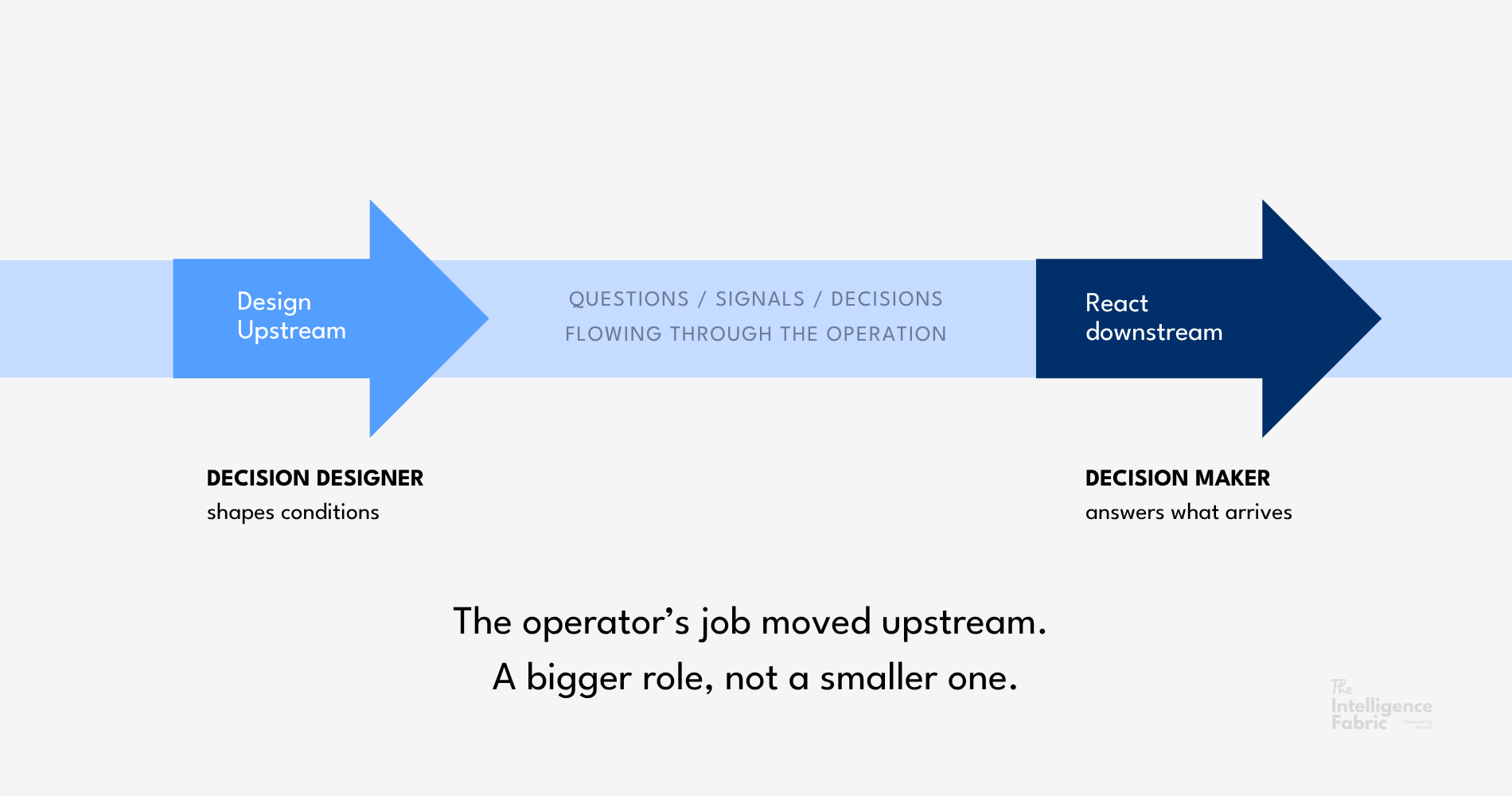
A decision-maker answers the question in the room. A decision designer builds the conditions where the right answer surfaces before the room has to convene. The question shifts from “what should we do today?” to “what needs to be true so the right action is already clear?”
That second question is architectural. It means looking at where meaning breaks down across the operation and building structure there: aligning metrics so teams tell a consistent story, designing processes that carry context through handoffs rather than stripping it out, and building feedback loops that surface consequences early enough for teams to act without escalation.
The Architecture Behind the Shift
Season 1 returned to the same structural question across every episode: why does intelligen ce stay trapped instead of moving? Fragmentation is the short answer.
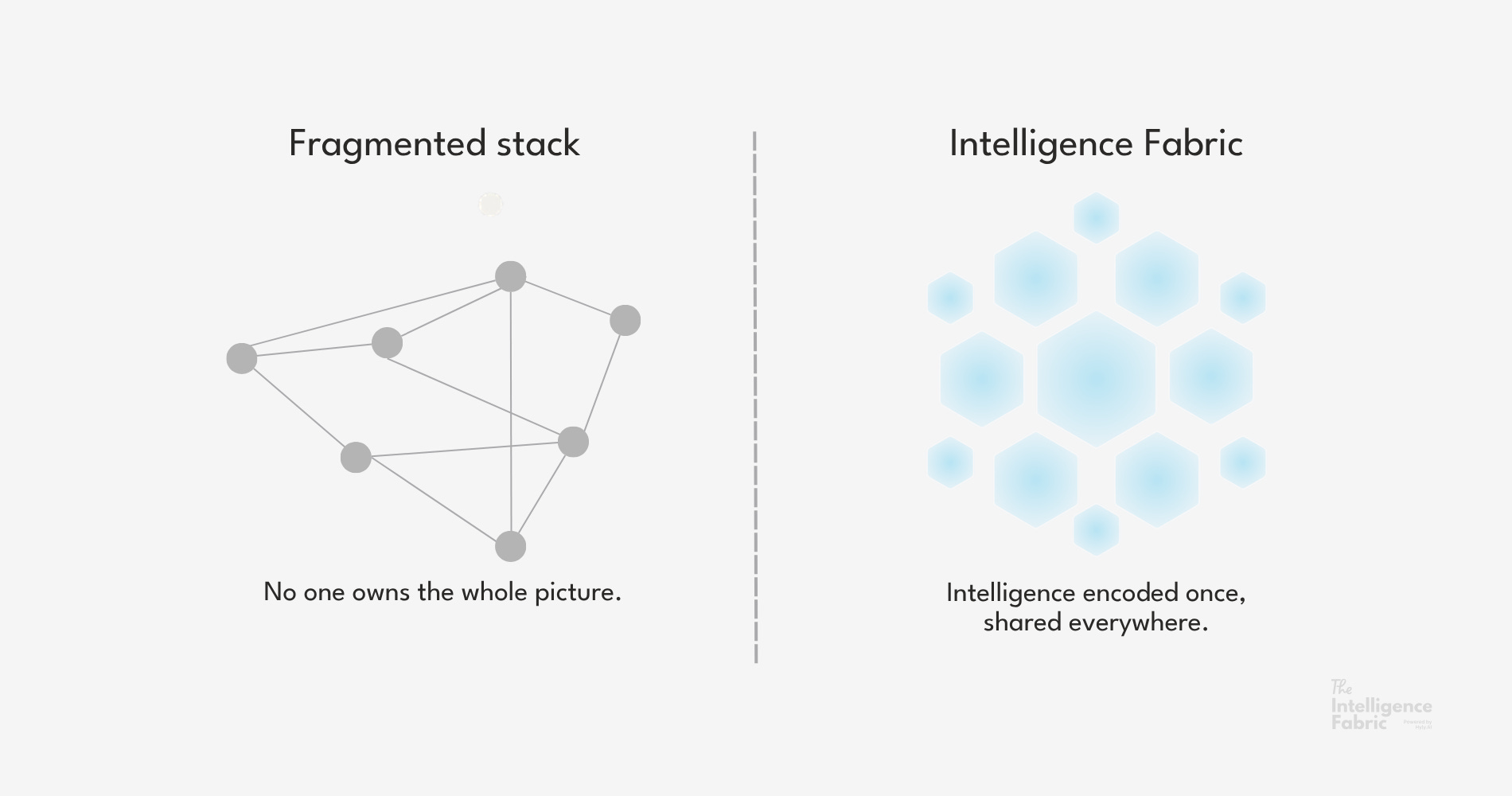
The deeper explanation is that the systems multifamily has built were designed to record activity, not to carry meaning across functions.
CRMs track what happens inside the CRM.
PMSs manage transactions within the PMS.
Marketing platforms send messages from their own data.
Each system does its specific job well.
None were built to explain what is happening across the whole operation, or to move context from one function to the next without a person doing that work manually at every step.
Intelligence Fabric is what changes this. It is the unifying business platform for multifamily:
a system designed to sit above PMS, CRM, and marketing automation, connecting signals into context and context into decisions. It brings together artificial intelligence, business intelligence, and human intelligence into a structure where knowledge is encoded once and distributed across the portfolio. Data-to-dollar pipelines replace manual reconciliation. Reusable intelligence replaces the workflows rebuilt from scratch at every property, every quarter, every time a team member changes.
When Intelligence Fabric is working, pricing shifts do not catch leasing off guard. Service trends do not surface months later as renewal losses. Meetings do not open with teams comparing incompatible numbers. Information arrives with meaning already attached, at the moment a decision needs to be made, without requiring a senior leader to reconstruct the context first.
A leader can design an environment where the right action becomes obvious only if the environment is capable of carrying intelligence. Intelligence Fabric is the infrastructure that makes that possible at scale.
9 Episodes. 1 Conclusion.
Season 1 of The Intelligence Fabric examined fragmentation from every angle: attribution that could not tell the real story, dashboards that looked complete but left rooms without clear direction, pricing that optimized one variable and missed the rest, stacks that grew while manual work stayed exactly where it was. Each episode named a different face of the same underlying problem.
This is where it resolves. The operator’s job has changed. The model that worked when one person could hold the whole picture in their head runs into structural limits as the environment grows more complex.
The model that works now rewards the operator who builds a system that can carry more of itself, one that surfaces the right information at the right moment without requiring constant re-interpretation from the top.
The job has not become smaller. It has moved upstream. From answering questions to shaping the conditions that determine what questions even get asked. From decision-maker to decision designer.
That shift has a name. Intelligence Fabric is the platform that makes it real.
Season 2 is coming.
Watch Episode 9 of The Intelligence Fabric here:
What is still routing upward in your operation that should already be clear without escalation?
Hit reply. Every response gets read.