
When “Property Website” gets credit for everything, the problem isn’t the report.
The problem is what the report fails to carry: shared meaning.
And that brings us to the thread we promised to pull next:
Why Multifamily built the stack and forgot the fabric.
If you want the quick video version first, here’s Mike’s episode:
We didn’t under-invest in tools. We over-invested in them.
Let’s be honest. Multifamily isn’t short on tech.
Most teams have a full stack:
CRM
PMS
BI dashboards
ILS reporting
Ad platforms
email and nurture tools
Spreadsheets to glue it all together (because of course)
The stack is built. The data is there. The reports are there. The dashboards are there.
So why does work still feel like this?
You sit in a meeting, everyone shows up with numbers… and nothing moves.
Or worse: you move, but nobody feels confident about why.
It’s not because the tools are bad.
It’s because the stack was built to collect information.
Not to carry understanding.
The stack moves data. It doesn’t move meaning.
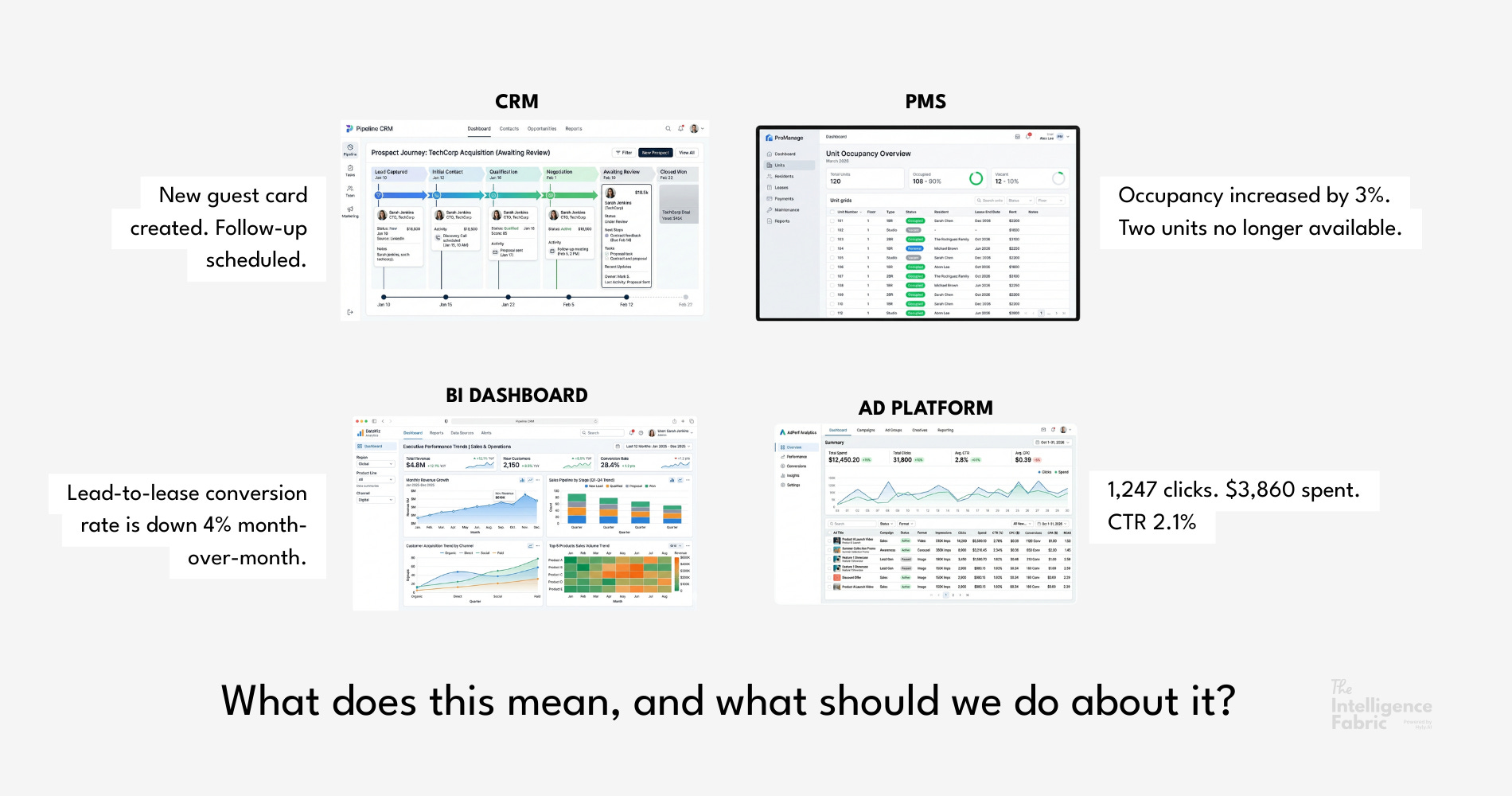
Here’s the trap.
A CRM can tell you a guest card happened. A PMS can tell you occupancy moved. A BI dashboard can show you trends. An ad platform can show you clicks and spend.
All useful.
But none of those systems can answer the question that actually decides what happens next:
“What does this mean, and what should we do about it?”
So we do what humans always do when meaning isn’t shared:
We interpret.
We explain.
We debate.
We forward screenshots.
We open 12 tabs.
We export a report “just to double check.”
We pull one more list “to be safe.”
And then the meeting ends with… “let’s regroup.”
Nobody’s phoning it in
The stack just hands everyone information without a shared story.
One multifamily operator told that owners don’t usually ask for “more KPIs.” Most just want the simplest story: spend down, revenue up.
But when the data isn’t clean enough to trust, you can’t even tell that story with confidence.
This is why meetings multiply
When meaning isn’t built into the system, meaning gets rebuilt in the room.
Every single time.
That’s the “space between information and action” we talked about in Newsletter #1.
And it’s why “same numbers, different conclusions” keeps happening.
Four people can look at the same report and walk away with four different answers because the stack didn’t carry context with the data.
It only carried the data.
So the intelligence ends up living in:
whoever has been there the longest
whoever knows how to translate the report
whoever remembers what happened last quarter
whoever has the “real story” in their head
Which feels normal… until someone leaves.
Then suddenly, you realize your company’s intelligence had a bus factor of one.
A quick gut-check: do you have a stack… or a stack and a fabric?
If you’ve ever heard any version of these lines, you already know the answer:
“Hold on… that’s not the number I have.”
“It depends which report you’re looking at.”
“Let me check with ___, they’ll know what’s really going on.”
“We should probably add a meeting with ops before we decide.”
“Can you resend that spreadsheet? The dashboard isn’t matching.”
None of that is a productivity problem.
It’s a structure problem.
Because the work isn’t happening in the tools.
The work is happening in the gaps between them.
So what’s the “fabric,” in plain English?
If the stack is all the systems you’ve bought, the fabric is what makes those systems act like one shared brain instead of a pile of separate stories.
It’s the layer that carries:
shared meaning (so marketing + ops + leadership aren’t translating the same report in three different languages)
portable understanding (so intelligence doesn’t walk out the door when someone quits)
reusable judgment (so you don’t restart every decision from zero every Monday)
Or said even simpler:
The stack tells you what happened. The fabric helps your team agree on what it means.
And when meaning is shared, decisions move.
One operator we spoke with uses a “data cleanliness score” out of 100.
Below 50, the tool becomes noise.
At 75+, they’ll act — and they’ll defend decisions to owners with confidence.
That’s the missing layer: a shared standard for what’s reliable enough to move budgets.
3 signs you built the stack and forgot the fabric
You don’t need a new vendor list to diagnose this. You just need to listen to your own meetings.
1) Same report. Different story.
Marketing says lead quality.
Ops says turns.
Finance says expenses.
Leadership says seasonality.
Everyone has a plausible explanation. And the room still can’t land the plane.
That’s what it looks like when meaning isn’t shared.
2) Decisions depend on who’s in the room.
If the right person shows up, the call gets made.
If they don’t, the meeting becomes “let’s circle back.”
That’s a sign the intelligence lives in people’s heads, not in the system.
3) Every meeting starts from zero.
You spend the first 20 minutes re-explaining the numbers, the context, the history, and the “real story” before anyone can even discuss what to do.
That’s how you end up rebuilding understanding from scratch, every single week.
Here’s what the fabric changes (and why it matters)
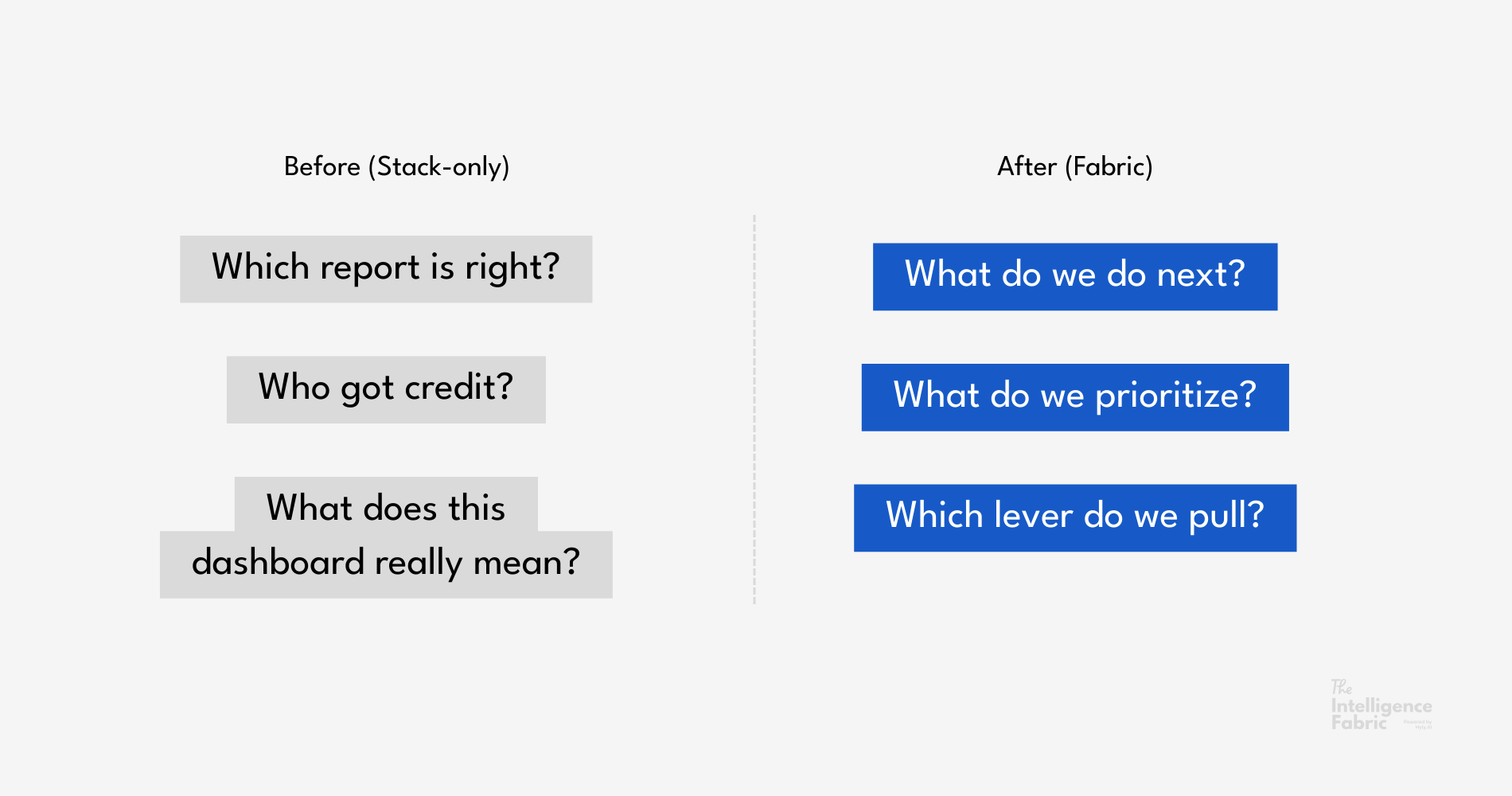
When a fabric exists, something flips.
Teams stop arguing about:
whose report is right which source “got credit” what the dashboard “really means”
And they start arguing about:
what to do next what to prioritize which lever to pull
That’s the difference between being busy and being aligned.
It’s also why last week’s attribution conversation matters.
Because attribution is just one example of a stack problem:
The system gives you a clean label (“Property Website”.
But it doesn’t carry the full context of the journey.
So humans fill the gap. In meetings. With debate.
A fabric doesn’t magically remove complexity.
It just stops forcing humans to rebuild meaning from scratch every time.
And it changes how ROI conversations sound.
Instead of “here are features,” the best operators go straight to: “here’s what we’ll change in the budget to make room for it.”
That only works when you trust your data enough to shift spend with confidence.
A Monday meeting thought experiment
Let’s make this concrete.
Three properties show a dip in tours.
Stack-only version:
Someone pulls the marketing dashboard.
Someone pulls the PMS.
Someone pulls call volume.
Someone says “it’s the ILS.”
Someone else says “it’s pricing.”
Then someone says, “Let’s wait until next week and see if it corrects.”
Fabric version:
where the tour drop starts in the journey
which channels stopped moving which milestone
what changed right before the dip
and whether this is a marketing problem, an ops problem, or a pricing problem
So instead of “let’s regroup,” the meeting ends with:
“Here’s the call.”
Not a guess. A decision.
And that’s when decisions start compounding instead of resetting.
Before we go, notice this in your next week
If you catch yourself saying,
“We have the data… but we can’t agree,” pay attention.
That line usually means the tools did their job — they produced numbers — and now humans are stuck doing the hard part: turning those numbers into a shared story.
Which is exactly what Mike’s been circling in the first three episodes: fragmented signals, intelligence living in people’s heads, and systems that don’t talk to each other.
In the next episode, he’s sitting down with Tyler Holmes from PeakMade to show what it looks like when that starts to change.
Not in theory.
In real operator moments:
when reporting finally stops being narrative
when “manual stitching” disappears
and when decisions get faster because the signals actually connect
That’s next!
And if you’re reading this thinking “yep… that’s us,” and you want to see what it looks like on your portfolio data, grab a demo slot here → https://hubs.la/Q04253Gm0