

“A lot of us came from on site. And I know a lot of people end up on site from all over the place.”
That’s Sara Stiles, three and a half years into marketing at Hyly.AI, talking about how she landed in multifamily. Grew up around it because her mom worked in it. Took an on-site job during college because it was available. Never planned any of this, and stayed because the work turned out to matter more than she expected.
She’s describing the whole industry when she says that.
There’s no accredited pipeline feeding multifamily the way med school feeds hospitals.
The National Multifamily Housing Council points to a trillion-dollar industry housing 39 million Americans, run largely by people who found the door sideways and turned out to be exactly right for the job once they were through it.
Ask around your own team how people got here. You’ll get a shrug and a good story, not a five-year plan, and that shrug is exactly how this industry keeps finding its sharpest people.
That’s the opening of the latest episode of The Intelligence Fabric, with Sara.
If you skip the episode and only read this, you’re getting half of it. Watch it, then come back.
So What About The Tools We Hand Those People Once They’re Here?
That part didn’t get to arrive the same way.
Improvisation Is A Feature In People. It’s A Different Story In Software.
Say that back to yourself
The instinct that makes multifamily’s best people great is the same instinct that gets someone through a chaotic Tuesday at a lease-up: figure it out with what’s in front of you, right now, because the prospect is standing there and the tour isn’t going to give itself. That instinct built careers. It’s also, understandably, how most tech stacks in this industry got built.
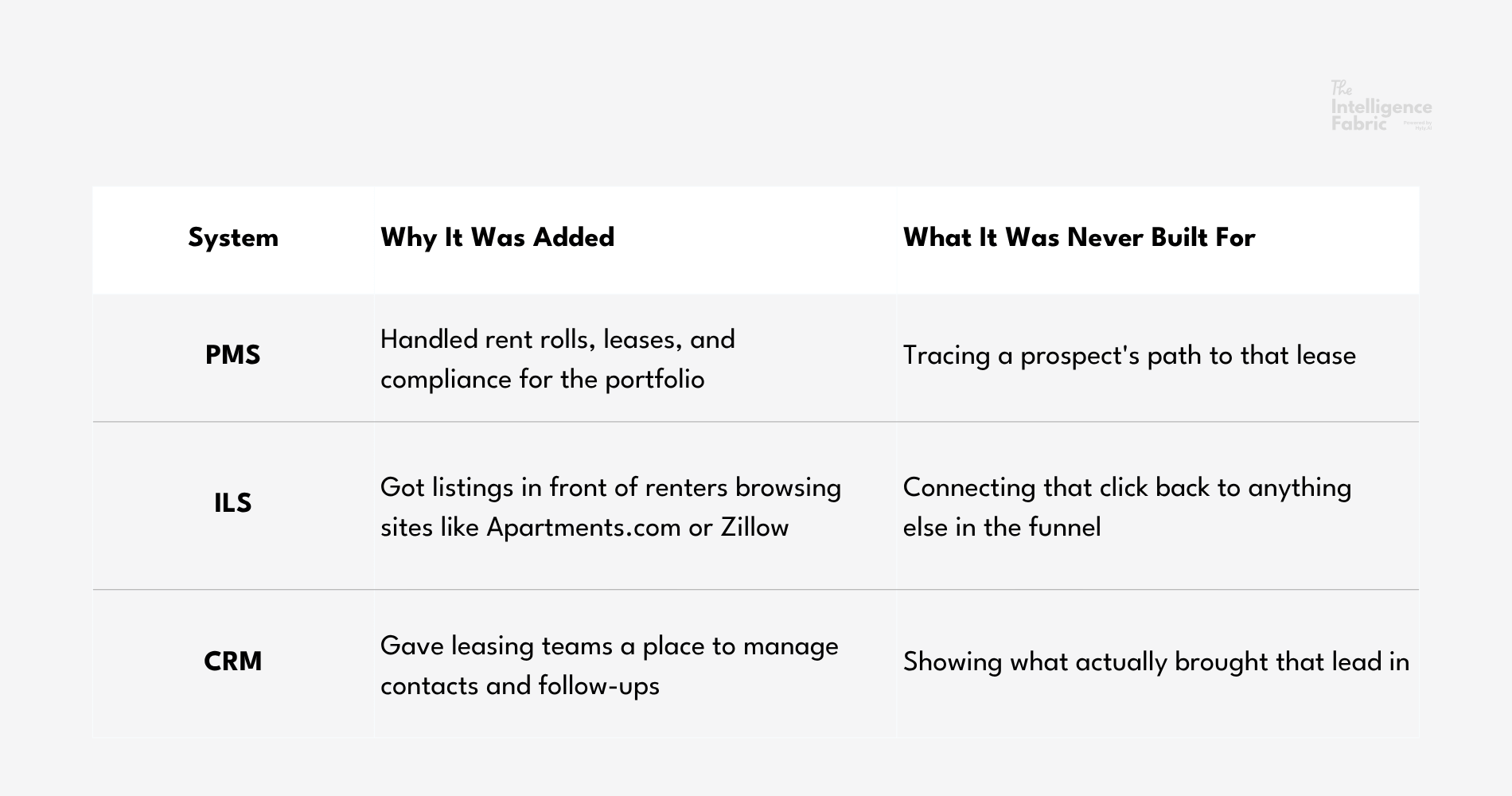
Every one of those was the right call in the moment it was made, by someone solving a real problem with what was in front of them. Nobody was ever specifically tasked with making sure all of it would agree with itself five years later, because that was never anyone’s job to begin with.
One property management technology analysis describes where that leaves most operators today: dozens of logins across dozens of systems that were never built to talk to each other.
A Forbes Business Council look at the multifamily tech stack names the daily version of it: rent roll in the PMS, leasing activity in the CRM, capital planning in a spreadsheet. Integrations get sold as the fix, and mostly they’re a one-way street, moving data from one system to another without a shared language for what any of it actually means once it lands.
IF your systems all report accurate numbers and none of them agree with each other, THEN nothing went wrong.
Every tool did exactly what it was asked to do. It’s just that nobody was ever asked to design what happens when you put all of them in the same room.
Thirteen Years On The Same Question
Multi-touch attribution isn’t a new idea chasing a new problem.
For most of the industry’s history, PMCs ran on first-touch or last-touch models: whichever channel happened to touch the lead last, usually the website form, got full credit for the lease. Everything before that, an ad scrolled past, an ILS listing clicked once and abandoned, a drive-by glance at a sign, disappeared from the record entirely.
The report said the website converted the lead. The website just happened to be standing there at the end.
Conversations about fixing that started showing up in NAA sessions and marketing roundtables as far back as 2013, arguing that a renter’s real path deserved more credit than whichever channel got the last click.
That’s not a small thing to notice. It means the industry correctly identified this gap over a decade ago, before most of the platforms running today’s stacks even existed. RealPage, Yardi, Entrata, and a long list of point-solution ILS and CRM tools have all been rebuilt, replaced, or upgraded at least once since then. The question that opened those 2013 sessions- how do we credit the touch that actually mattered instead of just the last one- is the same question still opening budget meetings in 2026.
That timeline says something real, and it’s genuinely good news: the operators who’ve been chasing this for over a decade were never behind. They were early to a problem that needed a layer nobody had built yet.
IF operators have been asking the same attribution question since 2013, THEN this was never a tooling gap.
It was a missing layer. A specific, buildable thing that just hadn’t been built.
The Layer That Gets To Be Designed On Purpose
Multifamily’s people got to be improvisational because that’s genuinely one of this industry’s strengths. Its data stack inherited the same improvisational instinct by accident, because nobody ever got the chance to sit down and design the whole thing with the full picture in view.
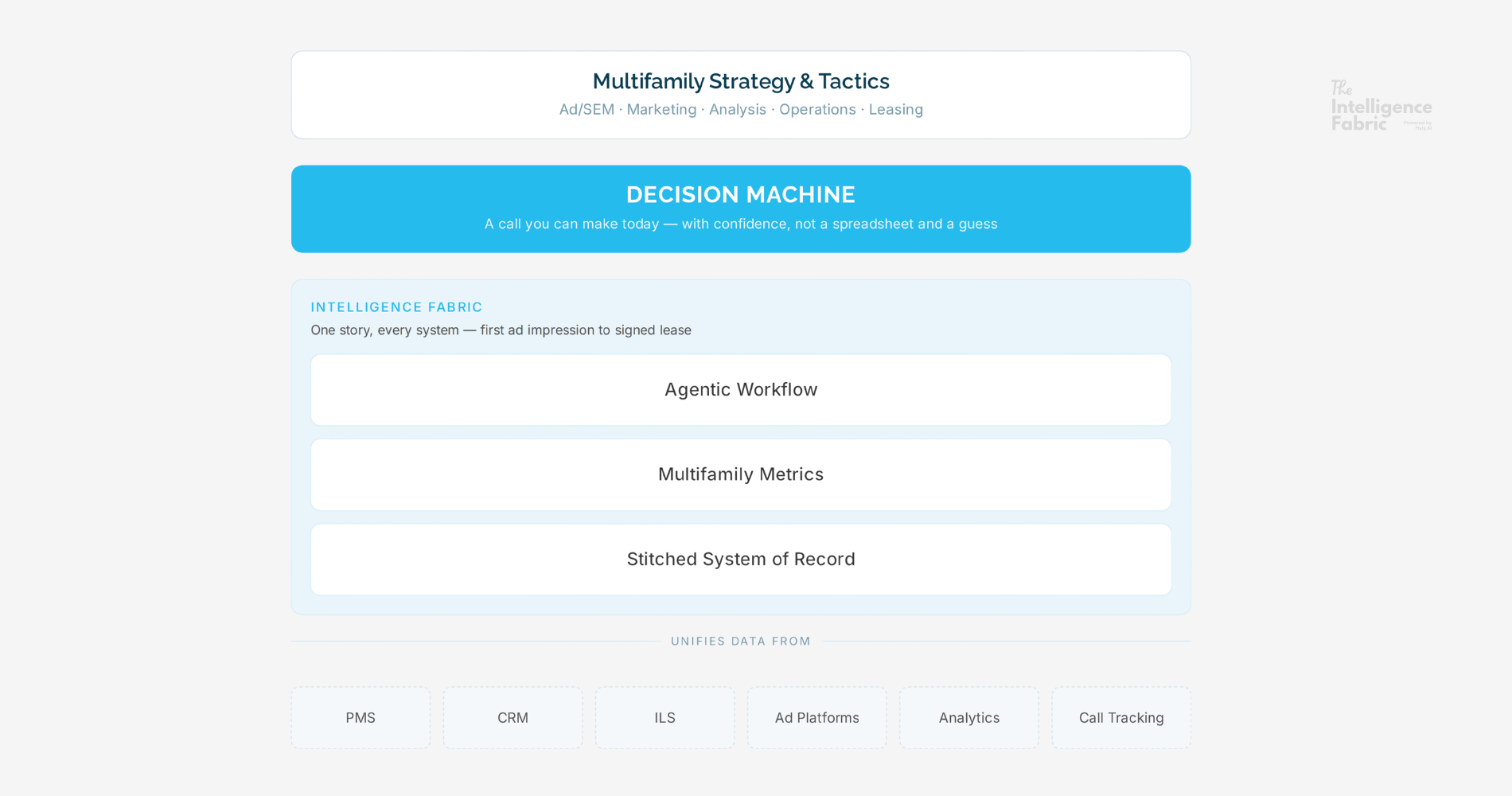
Intelligence Fabric is what that design looks like when it finally happens on purpose. It doesn’t replace the PMS, the CRM, or the ILS, and it isn’t a verdict on any of the choices that got made along the way.
Intelligence Fabric is the layer that sits on top of the stack, and connects every system’s version of a single prospect’s journey, from first ad impression to signed lease, into one story everyone agrees on.
Once that picture is actually connected, the question stops being what happened last quarter and starts being what to do about it right now. That’s the DECISION MACHINE: not another report explaining the past, but the layer that turns over a decade of hard-won, hard-earned data into a call someone can make today, with confidence instead of a spreadsheet and a guess.
The people in this industry have always found the right answer, whatever path got them there. Now the data gets to work the same way, on purpose, instead of by chance.
What’s the one part of your stack you’d love to finally see agree with the rest of it?
Reply and tell us. We’re collecting these.