
A few years back, AI and automation were the new thing in multifamily. Every conference talked about it. Every operator was trying to figure out where it fit. That trend is not new anymore. Most multifamily operators are several years into it now, and it shows.
Response times measured in minutes instead of hours and days
Chatbots handling early-stage prospect questions before a leasing agent ever gets involved
Automated follow-up sequences that don’t forget and don’t get tired
Branded email campaigns triggered by behavior instead of a fixed weekly send
Systems that can already tell whether a prospect wants to click and apply or wants an actual conversation
Dashboards updating source, spend, and conversion in real time
None of that is the frontier anymore. It’s baseline. Most operators are already running some version of all six.
What’s still open is the layer underneath it. Now that the data is finally right, what do you actually do with it? What counts as intelligence, versus another report that looks correct and changes nothing.
That is the exact discussion Robert Lee got into on Episode 2 of The Intelligence Fabric. If you skip the episode and only read this, you’re getting half the argument. Watch it, then come back. This goes further than a 30-minute conversation has room for.
Multifamily spent years chasing attribution like it was the hardest problem the industry had. Get that right, everyone assumed, and the rest follows. Then it got solved. And the question that came right after wasn’t about attribution at all.
“This is great. What do I do with it?”
What Attribution Actually Solved
Here is a single prospect’s path into one of your communities.
They see a paid search ad on a Tuesday and don’t click it.
Three days later, they scroll past the listing on an ILS site.
The following weekend they drive past the property on their way to somewhere else and glance at the sign out front.
Eventually they land on the website directly and submit a lead form.
For years, that entire path lived nowhere. Only the last visible step, the website form, showed up in any report. Everything before it was invisible.
Robert Lee describes what it took to fix that, on Episode 2: pulling every touchpoint into one place. Every ad a person never clicked. Every visit to the website. The source, the moment they finally converted, which channel actually earned credit for the lead. The actual path, stitched together, step by step.
That’s what attribution was supposed to solve, and it did. It took years of foundational work to get there.
And once it was solved and installed for a real client, the response wasn’t a relief sigh. It was the same question again, from the other side of it: now that I can see the entire path, what do I do with it?
IF you can finally trace a prospect’s full journey and still don’t know what to change because of it, THEN attribution was never the finish line.
It just got you close enough to see the real problem clearly for the first time.
That gap, between a fully visible path and an actual decision, is where decision machines live.
What A Decision Machine Actually Is
Robert frames it as the shift from dashboards to decisions, and the distinction isn’t decorative.
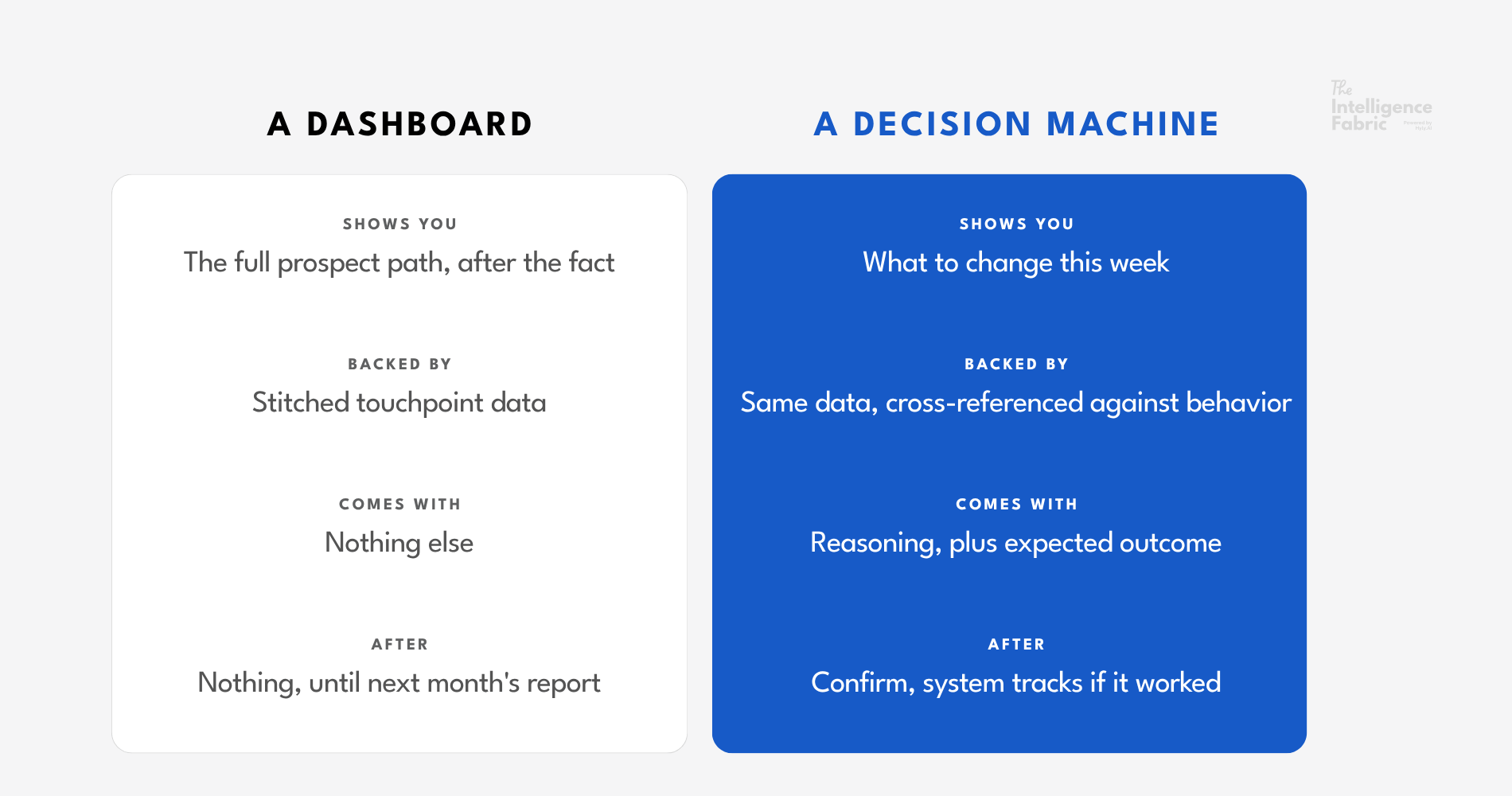
Now picture the next Monday running through the second version. Nobody is opening a report and starting from zero, reconstructing whether a channel is underperforming or just under-credited. Whoever owns that portfolio is reviewing a recommendation that already did that reconstruction, with the reasoning attached, and deciding whether to act on it.
The distance between “something is off here” and “here’s what we’re doing about it” stops being a multi-week investigation. It becomes a five-minute read before the first meeting of the day.
Where The Human Still Stands
Notice what doesn’t change. Whoever’s reviewing that recommendation is still the one who says yes. The reconciliation work that used to sit between seeing a problem and being able to act on it- that’s what gets automated. The decision itself still belongs to a person.
A decision machine removes the invisible research project standing between a person and the decision they were always going to have to make anyway. The call still belongs to them.
That judgment gets used differently now:
Every time a recommendation gets confirmed, or pushed back on, that reaction feeds into the system
That judgment doesn’t leave with the person the day they get promoted or take a job somewhere else
It stays. It compounds.
The next recommendation the system surfaces is sharper because that judgment is still in there, working
So here’s where the human actually stands. The job changed which tasks it’s made of.
Before: gather the data, reconcile the mess, decide. Most of the hours went into the first two.
Now: review, confirm or override, move on. The judgment call is the part left standing.
The Part That Got Skipped
That part never should have been automated away first, and mostly nobody tried. What got automated first was the follow-up email and the response time, the parts that were never where the real intelligence lived.
The reconciliation work a regional manager used to do quietly, off the side of her desk, every single month, sat there untouched the whole time. It was the hard part, and the hard part gets solved last.
Intelligence Fabric is built for the gap that opened up once attribution closed. The distance between a path that’s finally visible and a decision someone can stand behind before their next meeting.
What’s the prospect journey sitting in your CRM right now that you can finally see start to finish, and still don’t have a next move for?
Reply and tell us which one.