

Let’s start with a number that should bother you more than it does.
33%.
That is the annual turnover rate for onsite staff in multifamily. One in three of your leasing agents, property managers, and maintenance leads will be gone by this time next year. The national average across all industries is 22%. Multifamily blows past it like it isn’t even a speed limit.
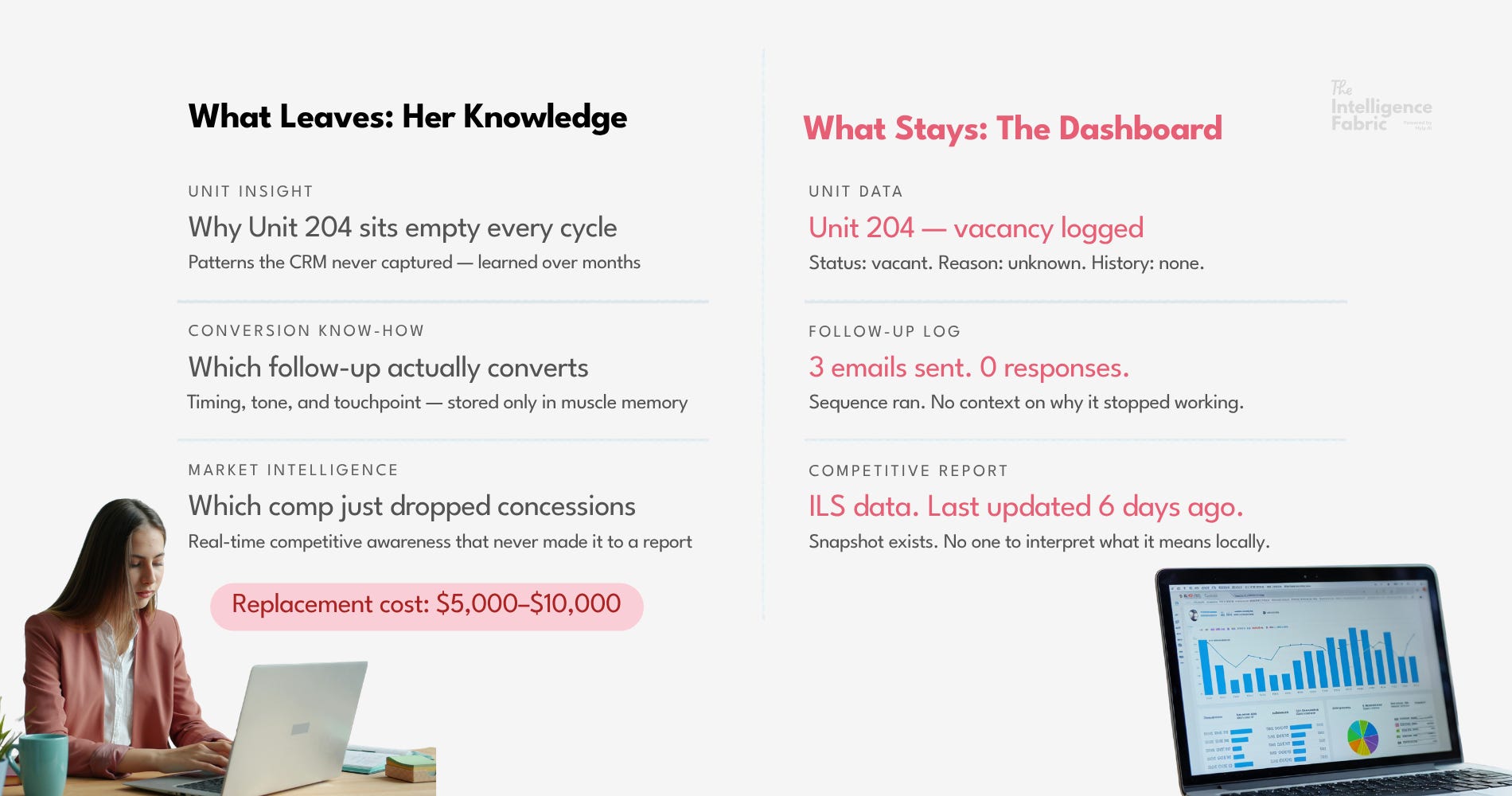
Replace one leasing agent and you are looking at $5,000 to $10,000 in recruiting, onboarding, and the two months of productivity you lost while the new person figured out which properties have parking problems and which residents require a very specific kind of patience.
And when that leasing agent walks out?
Everything she knew about why Unit 204 sits empty every cycle, which follow-up actually converts the tour-to-app, and which comp down the street just dropped concessions. All of it leaves with her badge.
You know what stays behind?
The dashboard. Completely intact. Full of numbers. Explaining nothing.
IF your intelligence lives in your people and not your systems, THEN you are not losing an employee. You are losing the answer to every question your reports cannot answer.
Meanwhile, the leasing market got slower while nobody was watching
Here is a fun fact that should be deeply unfun to anyone running a portfolio right now.
In mid-2021, the average unit in multifamily took 20 days to lease.
Today? 40 days. Double. Exactly double.
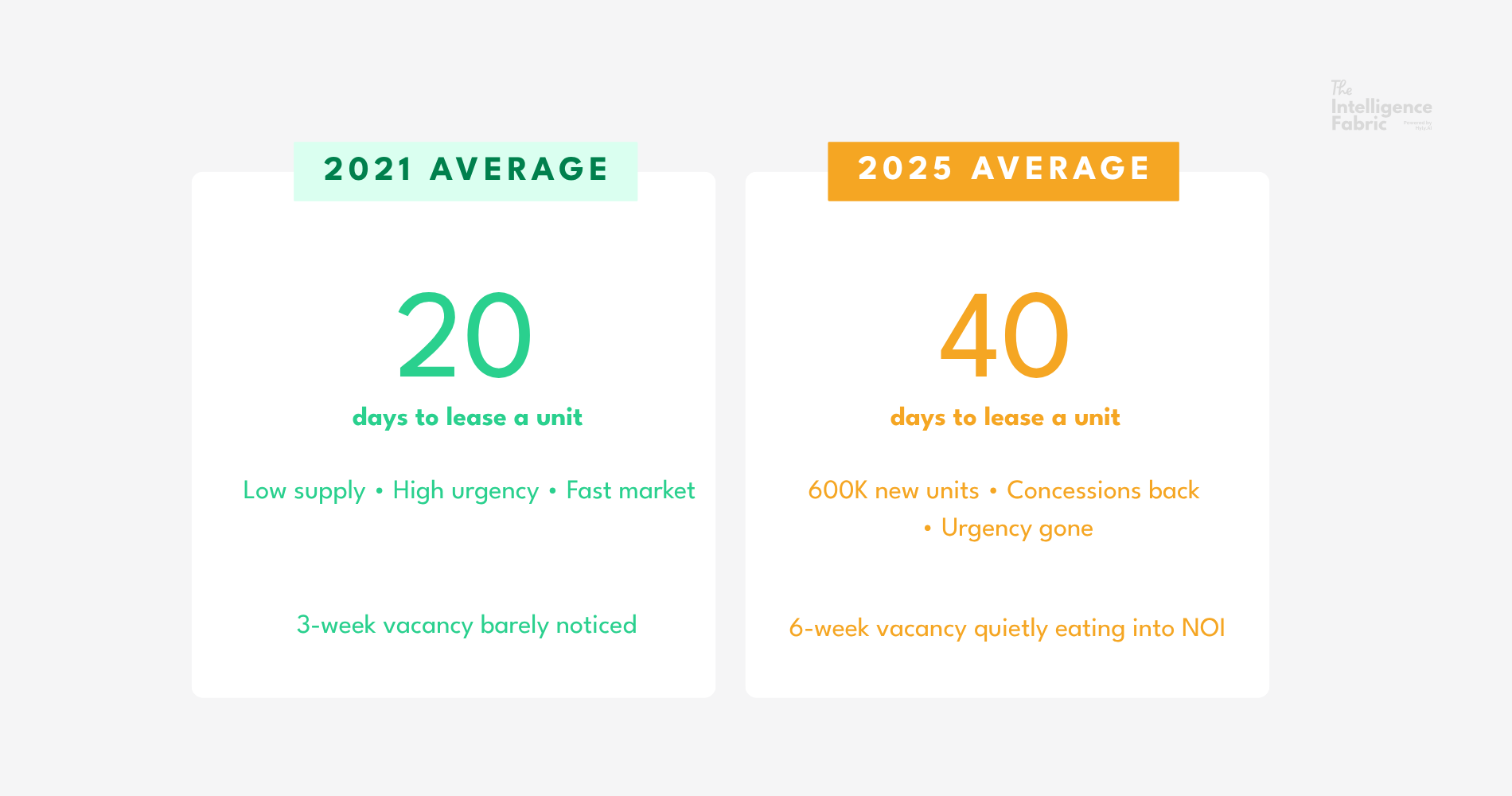
Two years ago, a unit sat empty for three weeks, and you barely noticed. Today, that same unit sits for six weeks and eats into your NOI with the quiet efficiency of a slow leak in a pipe you cannot find.
The market shifted. Supply came in hard. Nearly 600,000 new units were delivered in 2024 alone, with another half million landing in 2025. Prospects have more choices. Concessions are back. The urgency that made 2021 look easy is gone.
And operators are still running the same playbook.
More leads. Push marketing. Fill the top of the funnel.
Except here is what is actually happening to those leads:
66% of your ad budget is going to campaigns that book zero tours.
Zero. Not low. Zero.
The campaigns look fine in the report. Lead volume is up. The website is the top source, because it always is, because your CRM gives all the credit to the last click, and the last click is almost always the website. The ILS that started the prospect’s journey gets nothing. Google gets nothing. The retargeting ad that brought them back gets nothing.
You have been building your budget on a story your system made up.
IF your property website shows up as 60% or more of your lead source in every single report, THEN your attribution is broken.
The website did not drive those leases. It just happened to be standing at the finish line.
The $1.2 million hiding in your CRM right now
A Top 50 NMHC operator did an honest audit of their CRM across 46 properties.
119,386 leads. All marked lost.
Teams had written them off, reasonably. Prospects went quiet. No response. The pipeline looked thin, so everyone kept spending to generate fresh leads at the top while the existing ones sat there, marked dead.
Except they were not dead.
They were opening emails at 11 pm. Coming back to check the floor plans. Revisiting availability pages three weeks after going quiet.
The interest was completely alive. The system had labeled it as gone.
When behavioral signals finally got connected to leasing action, automatically and not manually, 51 applications came back from leads the CRM had buried. One property: $144,000 recovered. Across all 46: $1.2 million.
No new campaign. No bigger budget. The money was sitting in the database the whole time, mislabeled as a dead end.
The leads were never the problem. The context was. The system knew people were in the database. It had no idea they were still interested. That one missing piece of context cost $1.2 million before anyone noticed.
Three accurate reports. One completely wrong conclusion.
Here is what actually happens in a multifamily leadership call in 2025.
Eight people. One shared report on the screen.
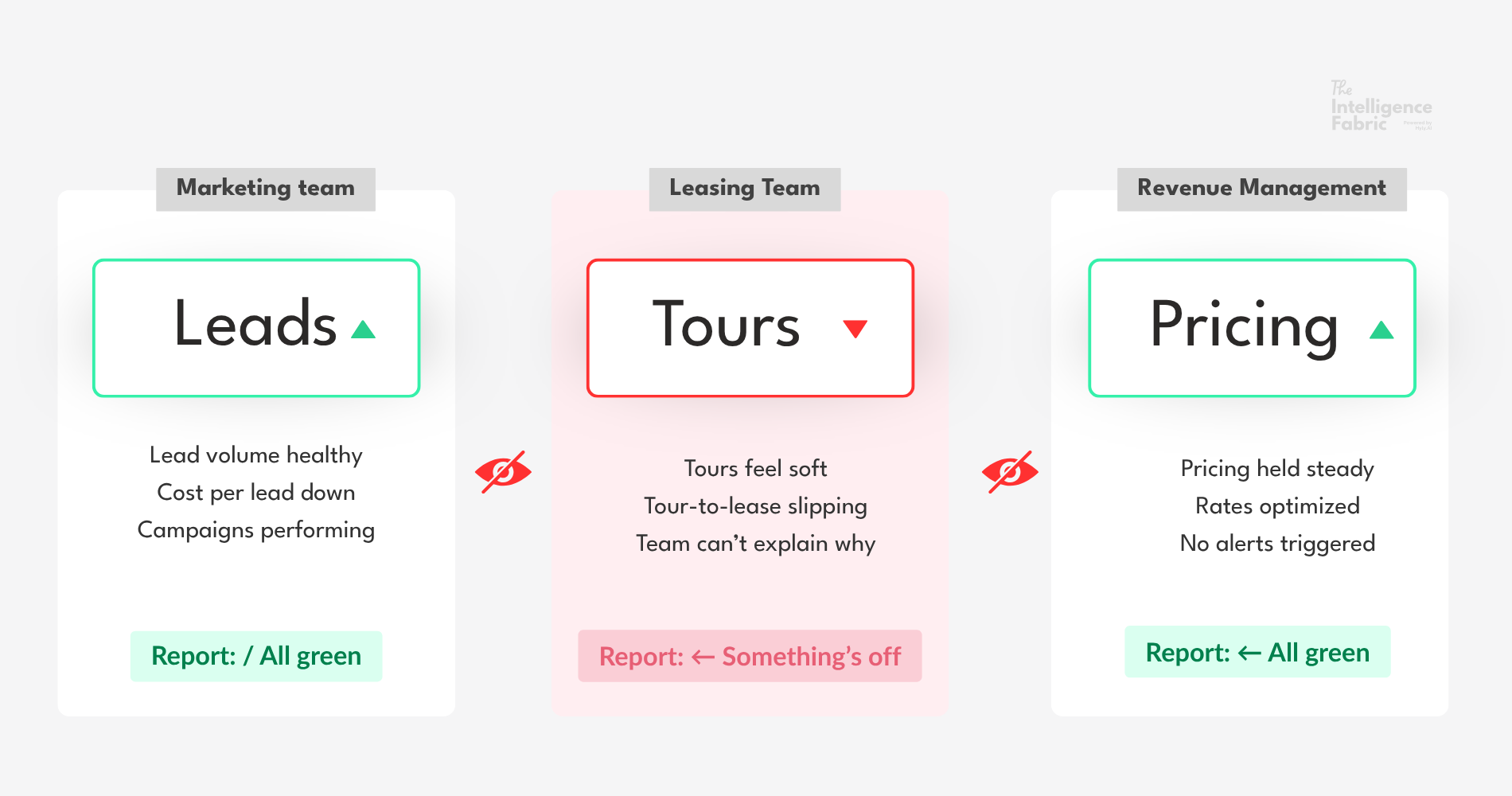
Marketing says lead quality is up. Leasing says tours feel soft. Revenue management says pricing is where it needs to be. Operations says something is off but cannot put a specific number on it.
The VP asks what is actually happening.
Fifteen minutes of theories.
Two action items nobody writes down.
A follow-up call.
This call has happened at your company. Probably last Monday.
Here is why it never resolves.
Marketing’s report is accurate for marketing.
Leasing’s report is accurate for leasing.
Revenue management’s report is accurate for pricing.
None of them shows what happened between those three functions over the last six weeks.
Nobody’s report connects a pricing call from week one to a tour slowdown in week three to the renewal conversations happening right now at those exact properties. The data exists. It lives in three systems that have never been formally introduced to each other.
So you have a room full of smart people, all holding one piece of the puzzle, all confident in their piece, none of them able to see the whole picture.
And the call ends with a follow-up call.
That gap between the data and the decision, between the report and the read, between what three teams each saw and what nobody could see together, that is what the Intelligence Fabric exists to close. Not another dashboard. The fabric that carries context across the systems that never carry it themselves.
What Season 2 is — and what it is not
Season 1 ran nine episodes. Same crack, nine different rooms. The attribution lie. The $1.2M the CRM called dead. The regional, who is the only one who actually knows what is going on, right up until the day she leaves.
Season 2 is not naming it again.
This season sits with operators who hit the wall and figured something specific out. Real portfolios. Actual numbers. What broke first, what held, and what the Monday call sounded like after.
Every example in this newsletter is the same moment wearing a different outfit. A leasing agent leaves and the context leaves with her. A CRM marks a prospect dead because it had data but no story. Three teams show up to a call with three accurate reports and zero shared picture.
The data was always there. The context never traveled with it. And context is what nobody in multifamily has figured out how to keep.
Before you close this tab
Somewhere in your operation right now, there is a number that looks fine.
It has looked fine for weeks. Maybe months. Nobody has questioned it because nothing has broken yet and there is always something more urgent to deal with.
That number is not fine.
You already know which one it is. You have passed over it in every weekly report and told yourself you would dig into it when things slow down.
Things do not slow down.
The operators who figure this out first will not announce it. They will just start showing up to ownership meetings with cleaner answers. Their Monday call will end in twelve minutes. Their regionals will stop being the single point of failure between the portfolio and reality.
And the operators still waiting for things to slow down will keep scheduling follow-up calls to answer questions for which they already have the data.
The gap between those two operators is just one question they started asking that the report never asked for.
What is the number you keep nodding at?
Hit reply. Tell us what it is. Some of those replies become episodes.
Episode 10 is live
Mike Brewer on data that reports accurately and explains nothing. And the one question that changes what you do with it.
Watch it here →’
The Intelligence Fabric. A podcast and newsletter for multifamily operators who are done nodding at numbers they do not fully understand. If that sounds like someone you know, forward this to them.