
“Website is like 80% of your lead source. And that’s wild. What is that really telling you?”
That’s Tyler Holmes. He leads performance marketing at PeakMade Real Estate. That question, asked out loud in a reporting review, is what started an eight-month investigation into why the data said one thing and leasing velocity said another.
This issue is different from the first three.
We’ve spent three newsletters naming the cracks: the gap between information and action, the missing shared meaning, the intelligence trapped in tools and people’s heads. Today, Mike Brewer is sitting with someone who lived those cracks and then crossed them.
Here’s what Tyler found on the other side.
👉 New here? Quick context: this newsletter runs alongside The Intelligence Fabric — a podcast about how intelligence really shows up in multifamily. The first three episodes named what’s broken. This one shows what changes when it starts to get fixed.
Your Reports Aren’t Lying. They Just Can’t See Far Enough.
PeakMade knew what they wanted. Leasing velocity.
They were spending, doubling budgets, adding tools, and running campaigns. The reports coming back looked fine. KPIs were positive. Numbers were moving.
But leasing wasn’t.
When the team went looking for why, they hit the same wall most performance teams hit. The data existed, but it existed in pieces. Agency reports in one place. PMS data in another. Website analytics somewhere else. To get a story coherent enough to bring to ownership, someone had to sit down and stitch it all together manually, comparing, reconciling, checking, re-checking.
Days and weeks of that. Every single month.
And even after all that time, the story they built wasn’t accurate. It was just presentable.
The most visible symptom: the property website was showing up as the source of roughly 80% of all leads. Eighty percent. Not because it was actually driving 80% of the journey. Because the system was defaulting, assigning credit to the last thing a prospect touched before filling out a guest card.
The ILS that started the journey? Invisible.
The retargeting ad that brought them back? Invisible.
The organic search that tipped the decision? Invisible.
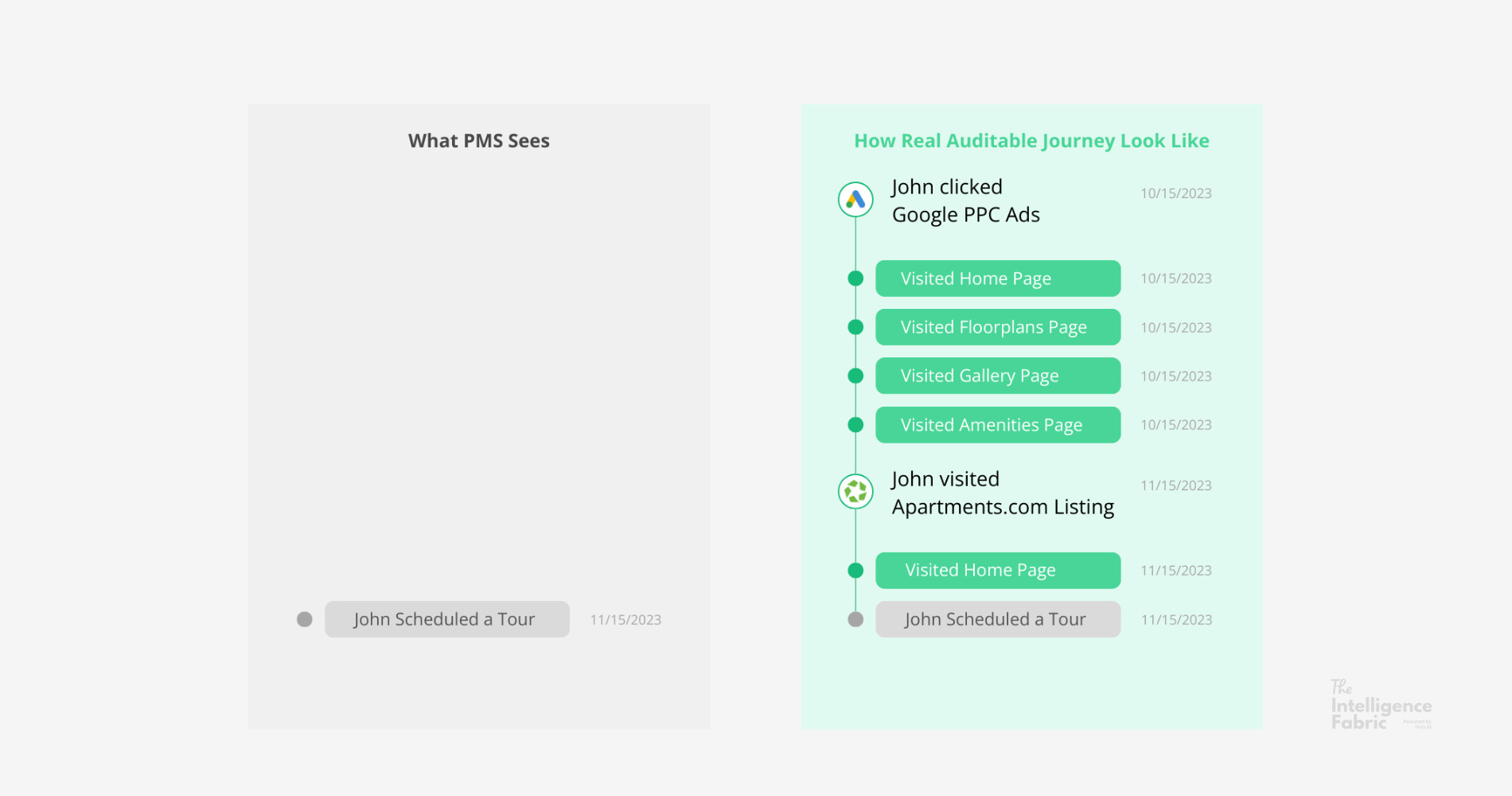
So the logical response looked like: drive more traffic to the website. Increase budget. More volume. That’s where the money went because the data didn’t have enough shape to point anywhere else.
IF your team is spending days reconciling before they can report, THEN they’re building the story instead of reading it.
IF ownership keeps asking “we spent more, why didn’t leasing move?” THEN the problem isn’t the channel. It’s that the data can’t show you where the problem actually is.
The result was a trust gap that quietly compounded. Clients who kept seeing “KPIs look good” next to “velocity isn’t moving” started treating recommendations as gut checks. And gut checks, however experienced the person giving them, are impossible to defend in a budget conversation.
“You’re basically giving us a gut check versus backing it up with data that really links the two parts together.”
That’s what happens when intelligence lives in fragments.
He Went Looking for the Answer Before Anyone Sold It to Him
Before Tyler adopted anything, he tried to understand the problem from the inside. He spent eight months researching attribution architecture, exploring platforms, and figuring out, in his words, how the sausage was made.
He found a platform that could theoretically connect everything. APIs to various sources, flexible enough to customize. It looked promising until it became clear the platform was built for multiple industries and lacked the nuance multifamily actually requires.
Student housing isn’t retail. A lease isn’t a transaction. The funnel has specific milestones that generic attribution models either flatten or miss entirely.
“Being able to try to take that on in-house would have been a massive undertaking.”
Then, at a conference, he heard about a team building attribution specifically for multifamily. The recognition was immediate. Eight months of looking, and someone was already building exactly what he’d been trying to build.
“This is what I’ve been looking at for eight months, but y’all are already doing it.”
That moment matters beyond Tyler’s story. It’s the answer to a question this Intelligence Fabric series keeps circling: why has multifamily lagged behind other industries on measurement?
Tyler’s answer is honest. For a long time, the leasing was still happening. Not great, but happening. Nobody was asking the right questions because the boat wasn’t visibly sinking. It was just moving slower than it should, burning more fuel than it needed to, and nobody could tell you precisely why.
The dog sitting calmly while everything burns in the background. Everything’s fine. We’re leasing.
That’s changing now, and faster than most people realize. A younger generation is coming into leadership roles. Vendors are finally investing real capital into multifamily-specific tools. AI is making certain lifts smaller and cheaper. A perfect storm, in Tyler’s words, of education, resources, and willingness to try.
The change isn’t coming. It’s already underway.
The Number That Disappeared When the Data Got Clean
The first thing that changed when Tyler’s signals connected wasn’t a better dashboard. Something he thought was fine turned out to be leaking.
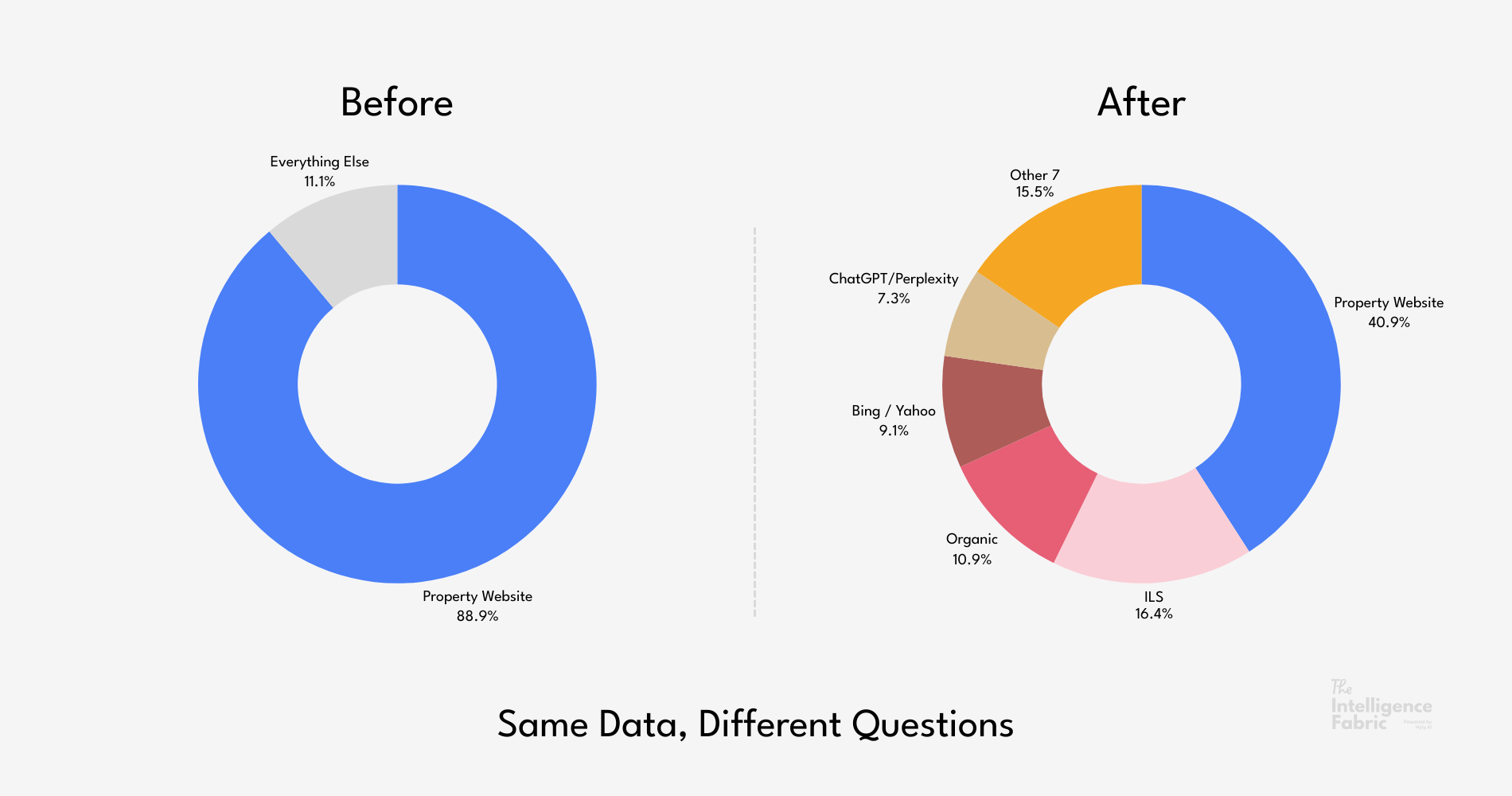
The website’s 80% lead share dropped to around 45%. That wasn’t a correction. It was the system finally seeing what had been contributing all along: ILS sources, organic channels, Bing, Yahoo, and traffic from ChatGPT and Perplexity. Real demand, completely invisible inside the PMS, never getting credit or budget protection.
But the number that actually moved things was in the funnel.
One property. Good leasing team, solid tour close rate. But between the tour and the application, prospects were going quiet. Nurture was running. Follow-up policy was in place. Everything looked right.
Milestone-level visibility revealed a timing problem. Prospects weren’t getting availability alerts tied to the specific units they’d toured. Communication was going out. It just wasn’t connected to where the prospect was in the journey.
They activated automated alerts triggered by each prospect’s specific interest.
Tour-to-application completion went up 30%. Cost nothing.
“Whereas if we didn’t have that data, we probably would have been spending more just to get more lead volume.”
The gap was always there. It just had nowhere to go.
When Data Ends the Debate
Once Tyler could see the full journey, client conversations changed. He got more specific. Specificity ends opinion-based debates.
A client wanted to go all-in on TikTok paid ads. Audience was there, engagement was high. Tyler had milestone data showing the intent wasn’t. People browsing TikTok aren’t apartment hunting. You don’t cannonball into that pool, in his words. You test, watch the funnel, and let the data tell you where to put the money.
Same with geofencing. A client wanted 100% of budget shifted there. Tyler came back with data showing where it was actually moving prospects through the funnel versus where the client assumed. The conversation moved from “trust us” to “here’s what the milestone data shows.”
Tyler used one word unprompted: education. When data backs a recommendation, clients receive it differently. You stop asking them to believe you and start showing them where the signal is.
That same clarity changed how Tyler approaches agencies. He moved from cost-per-lead to cost per milestone: lead, tour, application, lease. The questions got sharper. What keywords are we on? What negative terms have we added? Where in the funnel is this campaign having impact?
Agencies respond differently to that kind of question, because it holds the whole system accountable.
The Advice No Vendor Will Ever Put in a Pitch Deck
Near the end of the episode, Mike asked Tyler what the audience needed to hear that hadn’t been said yet.
What came back was practical. Almost blunt.
Start somewhere. Just start. If your team is small and your data is messy, that’s not a reason to wait. It’s a reason to begin with what you have. Connect what you can connect. Use the tools available to understand what your metrics actually mean before you do anything sophisticated with them.
And then, once you’re moving: don’t set it and forget it.
Adoption isn’t the same as implementation. Tyler’s edge came from staying inside the data, questioning what it showed him, and challenging partners when something didn’t line up. Owning the intelligence instead of outsourcing it.
“It’s your data. Own it. Use it. Challenge a lot.”
Watch the full episode:
Tyler spent eight months trying to build this himself before finding someone already doing it for multifamily.
The 30% lift wasn’t a marketing win. It was what happens when one invisible signal finally has somewhere to go.
If your team is still reconciling data before they can have the conversation, that’s the gap.
A fabric problem.